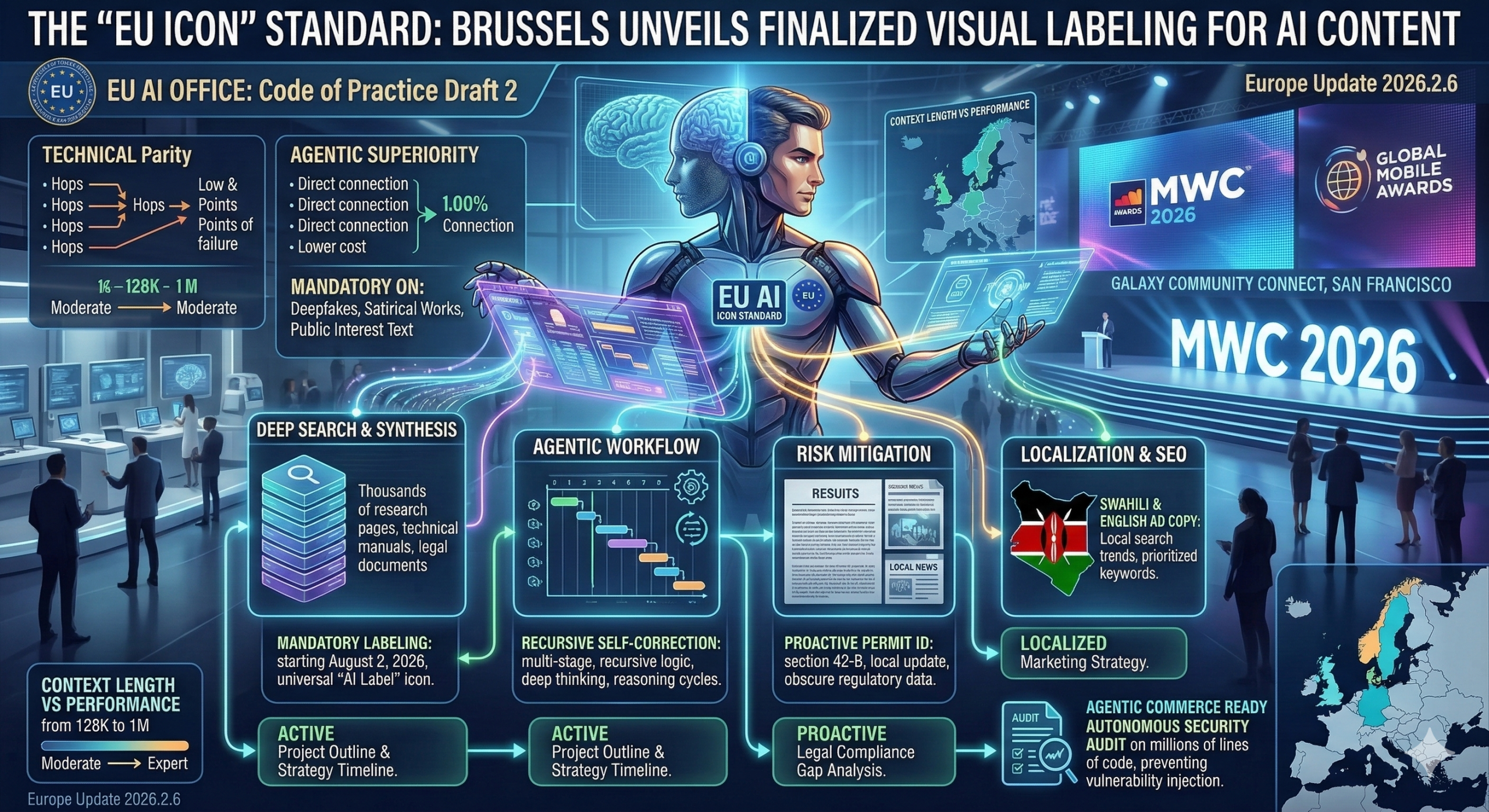
BRUSSELS — March 5, 2026 — The European Commission yesterday published the second—and nearly final—draft of its Code of Practice on Transparency, introducing a universal “AI Label” icon that will become a permanent fixture of the digital landscape. Starting August 2, 2026, this icon must be “instantly and constantly visible” on all AI-generated content across the European Union, marking the end of the “stealth AI” era.
The second draft, developed by the EU AI Office with input from over 100 stakeholders, refines the technical requirements of Article 50 of the AI Act. It moves away from the first draft’s complex taxonomy, instead favoring a streamlined, “visual-first” approach to help users distinguish between authentic and synthetic media at a glance.
The Iconography of Truth: “Instantly and Constantly Visible”
The most significant change in the March 2026 update is the strictness of placement and persistence. Under the new guidelines, the EU icon is not just a metadata tag; it is a physical requirement for the user interface:
-
Static Content: Images and text must feature a permanent icon placed consistently (e.g., in the top-right corner) that remains visible even if the content is shared or embedded elsewhere.
-
Live and Non-Real-Time Video: AI-generated video, including livestreams, must display a persistent, non-intrusive icon throughout the entire duration. For non-live video, this must be paired with a mandatory “opening disclaimer” at the start of the exposure.
-
Audio Content: For deepfake audio or synthetic voices, the Code mandates an “audible disclosure” at the beginning and end of the clip, paired with a visual icon if the audio is hosted on a visual platform.
“Transparency cannot be an ‘opt-in’ or a ‘click-to-reveal’ feature,” said the lead rapporteur for the Code. “To protect the integrity of the information ecosystem, the artificial origin of content must be as obvious as a watermark on a banknote.”
Narrowing the “Creative” Exception
One of the most debated sections of the Code involves satirical and artistic works. While Article 50 provides exemptions for “evidently artistic or satirical” deepfakes, the second draft narrows this loophole significantly:
-
Satire & Fiction: These works are now subject to “minimal and non-intrusive” disclosure. While they may not require the large, persistent icon of a political deepfake, they must still include a disclaimer (e.g., in end credits or a description) to prevent unintentional deception.
-
Public Interest Text: Any AI-generated text published to “inform the public on matters of public interest” (such as your personal injury lawyer blog or tech news summaries) must be labeled. The only exception is if the text has undergone “substantial human review or editorial control” where a natural person holds legal responsibility for the content.
Technical Enforcement: The Multi-Layered Approach
The Commission has rejected the idea of a “technical silver bullet.” Instead, it mandates a three-layer marking system for all AI providers:
-
Layer 1: Metadata. Machine-readable provenance info (C2PA) embedded in the file.
-
Layer 2: Watermarking. Imperceptible “interwoven” digital signals that survive cropping and compression.
-
Layer 3: The EU Icon. The visible, human-understandable label.
EU AI Labeling Roadmap: 2026
| Milestone | Date | Status |
| Second Draft Released | March 5, 2026 | Current Phase |
| Feedback Period Ends | March 30, 2026 | Upcoming |
| Final Code Finalized | June 2026 | Planned |
| Mandatory Application | August 2, 2026 | The “Hard” Deadline |
700 701 702 703 704 705 706 707 708 709 710 711 712 713 714 715 716 717 718 719 720 721 722 723 724 725 726 727 728 729 730 731 732 733 734 735 736 737 738 739 740 741 742 743 744 745 746 747 748 749 750 751 752 753 754 755 756 757 758 759 760 761 762 763 764 765 766 767 768 769 770 771 772 773 774 775 776 777 778 779 780 781 782 783 784 785 786 787 788 789 790 791 792 793 794 795 796 797 798 799 800 801 802 803 804 805 806 807 808 809 810 811 812 813 814 815 816 817 818 819 820 821 822