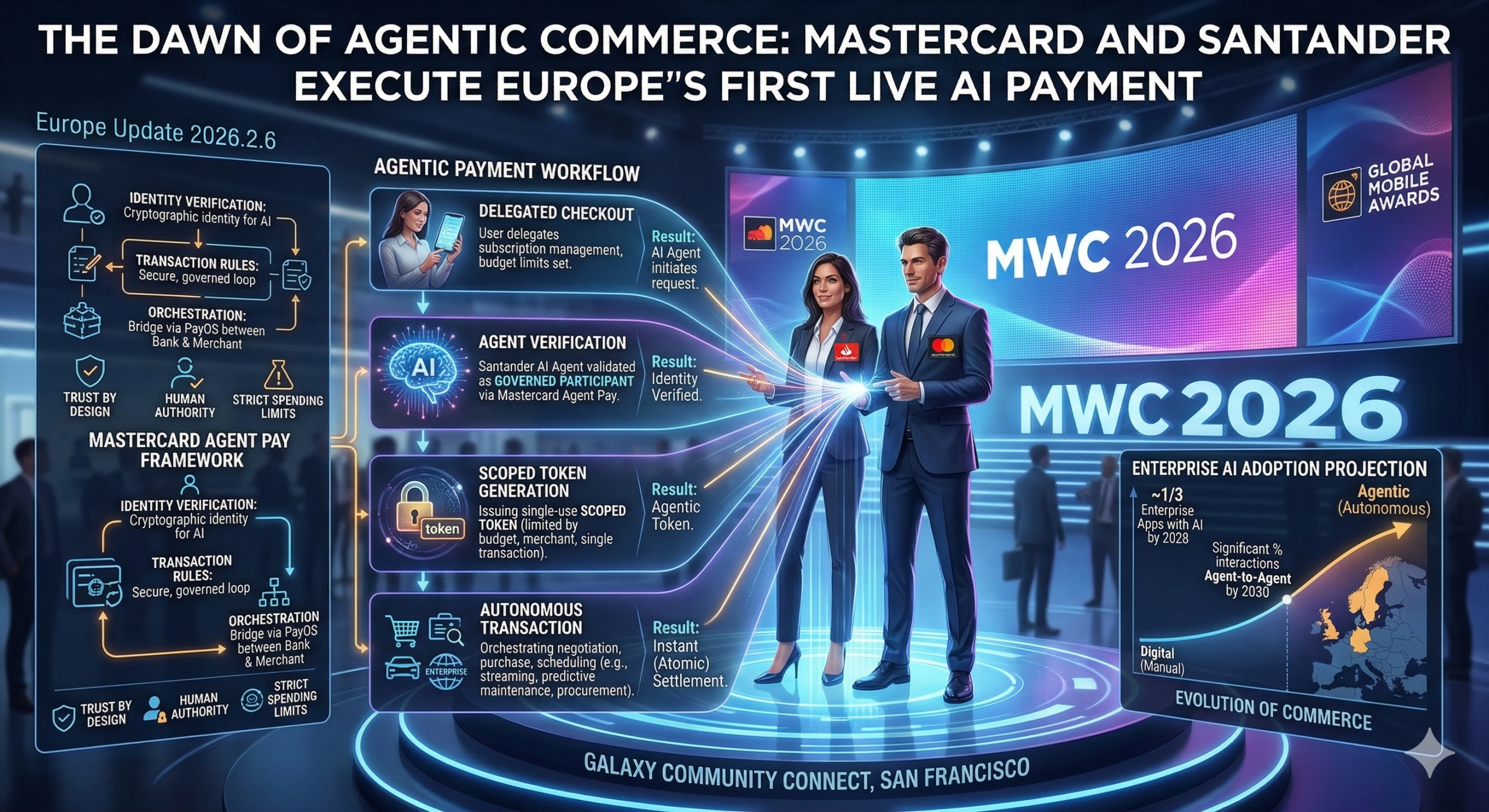
LONDON / MADRID — March 2, 2026 — In a landmark moment for the global financial ecosystem, Banco Santander and Mastercard today announced the successful completion of Europe’s first live, end-to-end payment executed entirely by an AI agent.
The transaction, conducted within a regulated banking framework, signals a structural shift in the global economy: the transition from “digital commerce” to “agentic commerce,” where autonomous software initiates and completes financial commitments on behalf of humans.
How It Works: The “Agentic” Handshake
The pilot took place in a controlled environment, utilizing Mastercard Agent Pay—a framework launched in 2025 designed to integrate non-human actors into existing financial rails. Unlike traditional automation, which simply follows a rigid script, the AI agent in this test acted as a “governed participant” in the payment flow.
-
Identity Verification: The AI agent was registered and verified with its own cryptographic identity, allowing the payment network to recognize it as a distinct actor rather than a spoofed human user.
-
The “Agentic” Token: Instead of exposing raw credit card data, the system issued a dedicated scoped token. This token was limited by specific parameters: it could only be used for a single transaction, with a predefined merchant, and within a strict budget limit.
-
Orchestration: The end-to-end process was managed by PayOS, which bridged the communication between Santander’s live banking infrastructure and the merchant’s acquiring bank.
Delegating the Checkout: The End of “Manual Entry”
The significance of this milestone lies in its potential to eliminate the “moment of effort” in everyday life. Within the next 12 to 24 months, Mastercard expects this technology to enable a variety of autonomous use cases:
-
Subscription Management: An AI agent could identify that a streaming service has raised its price, negotiate a lower rate with a competing provider’s agent, and switch the subscription—executing the final payment—without the user lifting a finger.
-
Predictive Maintenance: A smart car could detect a failing sensor, search for the best price at a local service center, schedule the appointment, and pay the deposit autonomously.
-
Enterprise Procurement: Corporate AI agents could manage inventory by automatically purchasing supplies when stock hits a certain level, ensuring they stay within a procurement team’s “pre-approved” budget and merchant list.
Governance and Security: Trust by Design
Matías Sánchez, Global Head of Cards and Digital Solutions at Santander, emphasized that while the AI acts with autonomy, the human remains the ultimate authority. “Our role is to shape this innovation responsibly,” Sánchez stated. “Building trusted, scalable frameworks is essential. We are embedding security and governance by design, ensuring the customer retains oversight through strict spending limits and permissions.”
Mastercard estimates that by 2028, roughly one-third of all enterprise software applications will incorporate agentic AI. By 2030, a significant percentage of all customer interactions will be handled agent-to-agent.
The Evolution of Commerce: A Comparison
| Era | Primary Interface | Initiator | Settlement Speed |
| Traditional | Physical Card / Cash | Human (Manual) | T+2 Days |
| Digital (2010s) | Web/Mobile Wallet | Human (One-Tap) | Real-time (approx.) |
| Agentic (2026+) | Conversational / API | AI Agent (Autonomous) | Instant (Atomic) |
700 701 702 703 704 705 706 707 708 709 710 711 712 713 714 715 716 717 718 719 720 721 722 723 724 725 726 727 728 729 730 731 732 733 734 735 736 737 738 739 740 741 742 743 744 745 746 747 748 749 750 751 752 753 754 755 756 757 758 759 760 761 762 763 764 765 766 767 768 769 770 771 772 773 774 775 776 777 778 779 780 781 782 783 784 785 786 787 788 789 790 791 792 793 794 795 796 797 798 799 800 801 802 803 804 805 806 807 808 809 810 811 812 813 814 815 816 817 818 819 820 821 822