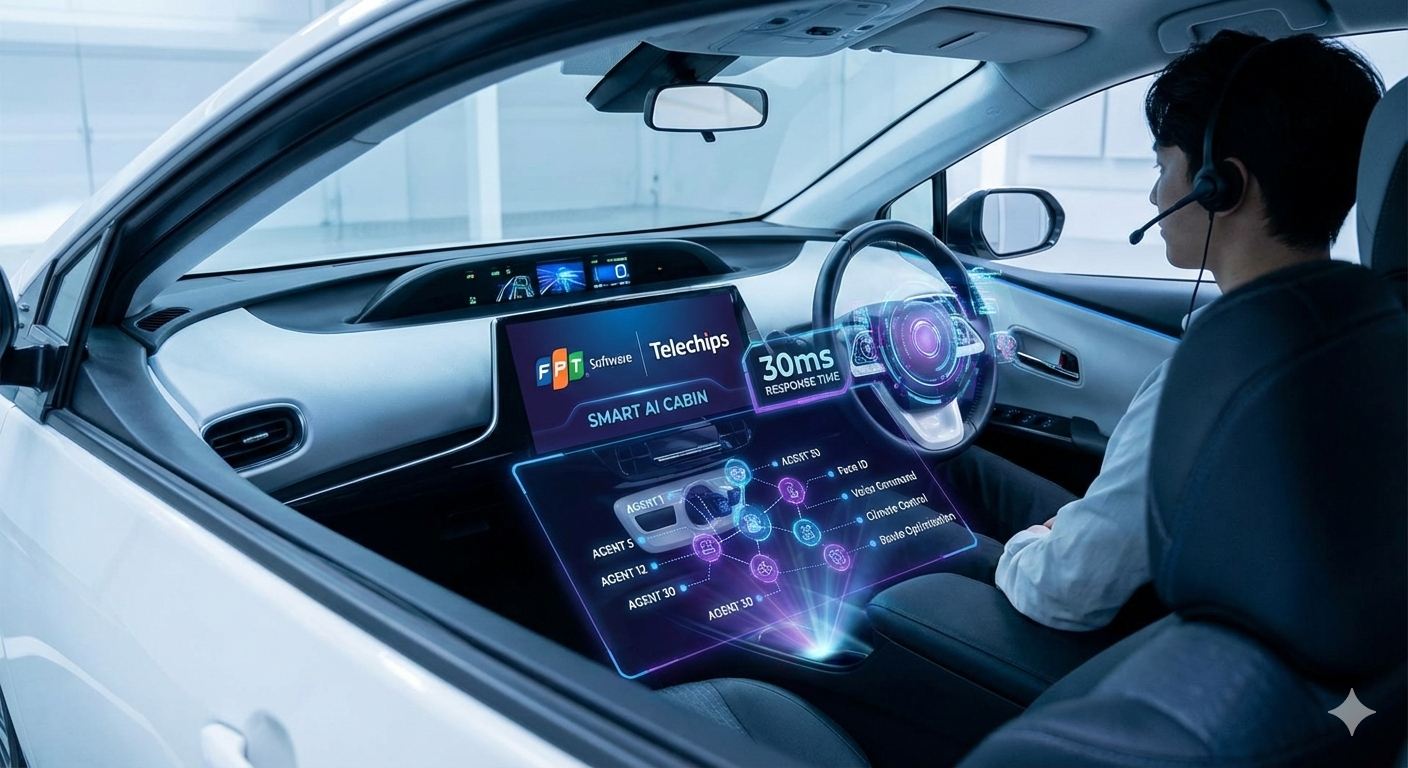
SEOUL, South Korea & HANOI, Vietnam – January 18, 2026 – The race to define the “software-defined vehicle” took a significant leap forward today as Vietnamese tech powerhouse FPT Software and Korean semiconductor leader Telechips announced a strategic collaboration to launch the “Smart AI Cabin.”
The new platform promises to revolutionize the in-car experience by severing ties with laggy, cloud-dependent systems. By utilizing a unique architecture of over 30 specialized, on-device AI agents, the Smart AI Cabin delivers near-instantaneous performance with a benchmarked response time of just 30 milliseconds (ms).
The End of the “Loading Spinner”
For years, “smart” vehicle features have been hampered by latency. A voice command to lower the temperature or find a charging station often has to travel to a distant data center, be processed, and bounce back to the car—a delay that feels eternal while driving at speed.
The FPT-Telechips collaboration addresses this bottleneck by moving intelligence from the cloud to the “edge”—directly into the vehicle’s dashboard hardware.
At the heart of the system are Telechips’ advanced automotive System-on-Chips (SoCs), known for their efficiency in handling multimedia and autonomous driving assistance systems (ADAS). FPT Software has built a sophisticated software layer on top of this hardware, orchestrating a decentralized network of more than 30 “local AI agents.”
Unlike a single, monolithic AI assistant, these agents are highly specialized micro-programs working in concert. One agent might be dedicated solely to analyzing driver gaze, another to cabin acoustics, a third to real-time battery thermal management, and a fourth to natural language understanding.
Because these agents process data locally on the Telechips hardware, they achieve a blistering 30ms response time—essentially imperceptible to the human brain, creating an interaction that feels completely fluid and natural.
Hyper-Personalization and Energy Efficiency
The companies highlighted several key capabilities of the Smart AI Cabin during the announcement:
-
Proactive Driver Preference Learning: The system goes beyond saving seat positions. The local agents analyze patterns over time—recognizing that a driver prefers a specific news briefing on Monday mornings but upbeat music on Friday afternoons, or automatically adjusting climate zones based on biometric stress indicators detected via cabin sensors.
-
Intelligent Energy Optimization: In the electric vehicle (EV) era, cabin systems are a major drain on range. The Smart AI Cabin’s agents actively manage power consumption, balancing infotainment needs, HVAC, and lighting in real-time to squeeze extra miles out of the battery without compromising passenger comfort.
-
Resilient Operations: Crucially, because the AI is local, core functions remain fully operational even when the vehicle enters tunnels, parking garages, or rural areas with zero cellular connectivity.
A “Plug-and-Play” Solution for Automakers
The partnership is strategically positioned to appeal to global Original Equipment Manufacturers (OEMs) struggling to build their own complex software stacks internally.
FPT and Telechips are marketing the Smart AI Cabin as a “plug-and-play” white-label platform. This allows automakers to integrate a top-tier, futuristic cockpit experience into their 2027 model lineups without spending years in R&D.
“The future of the automotive cockpit isn’t just about bigger screens; it’s about invisible, instantaneous intelligence,” said a joint statement from the companies. “By combining Telechips’ robust NPU (Neural Processing Unit) capabilities with FPT’s expertise in AI orchestration, we have created a platform that listens, thinks, and acts as fast as the driver.”
Industry analysts see this as a strong move for both nations. It solidifies South Korea’s position in advanced automotive silicon and showcases Vietnam’s rapidly growing capability in high-level software engineering and system integration on the global stage.
The first prototypes of cars equipped with the Smart AI Cabin are expected to be showcased later this year, with production integration targeted for late 2026 or early 2027 models.
700 701 702 703 704 705 706 707 708 709 710 711 712 713 714 715 716 717 718 719 720 721 722 723 724 725 726 727 728 729 730 731 732 733 734 735 736 737 738 739 740 741 742 743 744 745 746 747 748 749 750 751 752 753 754 755 756 757 758 759 760 761 762 763 764 765 766 767 768 769 770 771 772 773 774 775 776 777 778 779 780 781 782 783 784 785 786 787 788 789 790 791 792 793 794 795 796 797 798 799 800 801 802 803 804 805 806 807 808 809 810 811 812 813 814 815 816 817 818 819 820 821 822