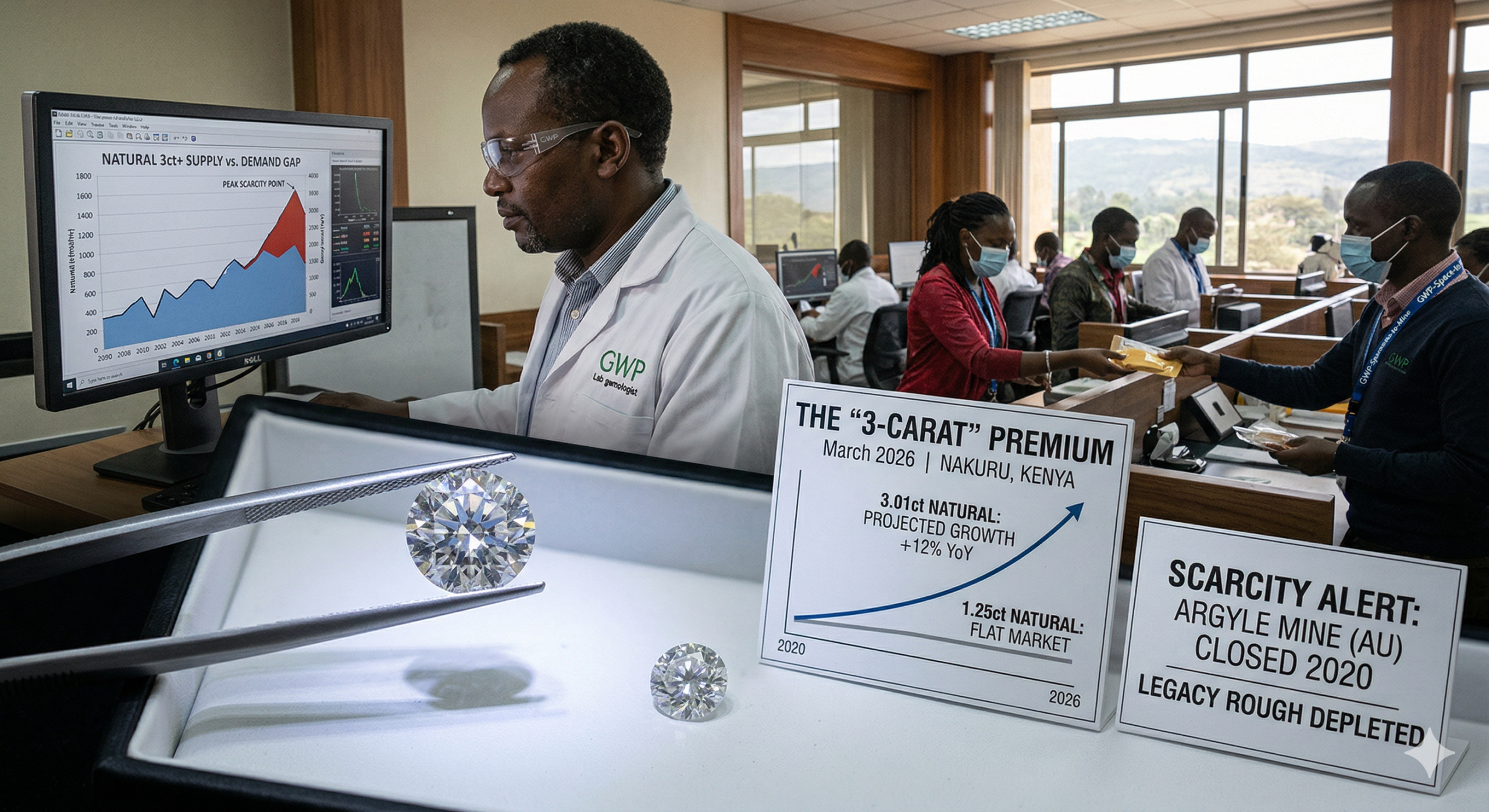
March 22, 2026 – For decades, the global diamond market was a largely homogenous structure: larger diamonds commanded higher prices, but the entire ecosystem moved in relative symmetry. In 2026, that symmetry is fractured. While smaller diamonds are struggling—faced with mounting competition from lab-grown alternatives and a shift toward color—a singular, powerful anomaly has emerged: the market for 3-carat natural diamonds is projected to grow by 12% this year, a phenomenon the industry has dubbed the “3-Carat Premium.”
This is not a story of generalized luxury growth; it is a story of engineered scarcity. The core driver of this 12% surge is a long-simmering inventory crisis that finally boiled over following the 2020 closure of the iconic Argyle mine.
The Anatomy of the Fractured Market
The 2026 diamond landscape is defined by two opposing trends:
-
The Small Diamond Struggle: Lab-grown gems, now mainstream, have captured a significant portion of the entry-to-mid bridal market, particularly for stones under 1.5 carats. Traditional miners of small rough are finding few buyers, depressing prices and volume.
-
The 3-Carat Natural Oasis: Stones in the “3-to-5-carat” sweet spot are experiencing white-hot demand, primarily from affluent, informed consumers who value two things: substantial visual impact and verifiable natural rarity.
The Argyle Legacy: A Void of “Perfect Rough”
When the Argyle mine in remote Western Australia shuttered its operations in November 2020, the world lost 90% of its supply of rare pink diamonds. This is well-documented. What is less understood is that Argyle was also a major, consistent producer of exceptionally large, high-quality colorless rough—the primary source material for cutting stones over 3 carats.
Mining operations are not like turning a faucet; they are slow-motion industrial ecosystems. The 3-carat stones reaching retail shelves today were mined, traded, cut, and certified years ago. In 2026, the global inventory of Argyle’s legacy large rough has been almost entirely processed and sold.
“There is a ‘valley’ in our supply chain,” explains Dr. Aris Thorne, a mineral economist specializing in high-value stones. “Argyle provided the baseline rough. Today, that baseline is gone. Mines in Botswana or Russia produce large rough, yes, but not in the consistent, high-clarity volumes Argyle did. We are now experiencing a genuine, verifiable gap in natural supply that is colliding with Peak 3-Carat demand.”
Price and Scarcity: A New Valuation Model
For consumers, the 3-Carat Premium is not theoretical. In major trading hubs like Eldoret and Nakuru, brokers report that the “price-per-carat jump” between a fine 2.5-carat stone and a comparable 3.0-carat stone has doubled since 2023.
| Feature | Fine 2.5-Carat Natural | Fine 3.0-Carat Natural | “3-Carat Premium” (2026) |
| Availability (2026) | Variable | Scarce | High |
| Supply Trend (2026) | Stable | Declining (-8% YoY) | Very Scarce |
| Avg. Price-per-Carat | $18,500 | $26,200 | +$7,700 (41% Jump) |
| Market Outlook | Soft | 12% Projected Growth | High Growth |
“If a 2.5-carat stone is ‘luxury,’ a true natural 3-carat stone is now ‘ultra-luxury’ because its replacement cost, in terms of finding the rough, is astronomical,” adds Jonathan Weiss, a broker in Nakuru. “We are valuing scarcity, not just weight.”
A Beacon in the Industry
The 3-Carat Premium is providing a crucial lifeline to natural diamond advocates. Miners and high-end jewelers are shifting resources, prioritizing the extraction and certification of larger stones over smaller volume. The strategy is to market 3-carat stones as a long-term alternative asset, a strategy that is paying off as the demand for unique, unheated colored stones like Cobalt Spinel also rises, creating a diversified high-value market where natural rarity is the universal currency of 2026.
700 701 702 703 704 705 706 707 708 709 710 711 712 713 714 715 716 717 718 719 720 721 722 723 724 725 726 727 728 729 730 731 732 733 734 735 736 737 738 739 740 741 742 743 744 745 746 747 748 749 750 751 752 753 754 755 756 757 758 759 760 761 762 763 764 765 766 767 768 769 770 771 772 773 774 775 776 777 778 779 780 781 782 783 784 785 786 787 788 789 790 791 792 793 794 795 796 797 798 799 800 801 802 803 804 805 806 807 808 809 810 811 812 813 814 815 816 817 818 819 820 821 822