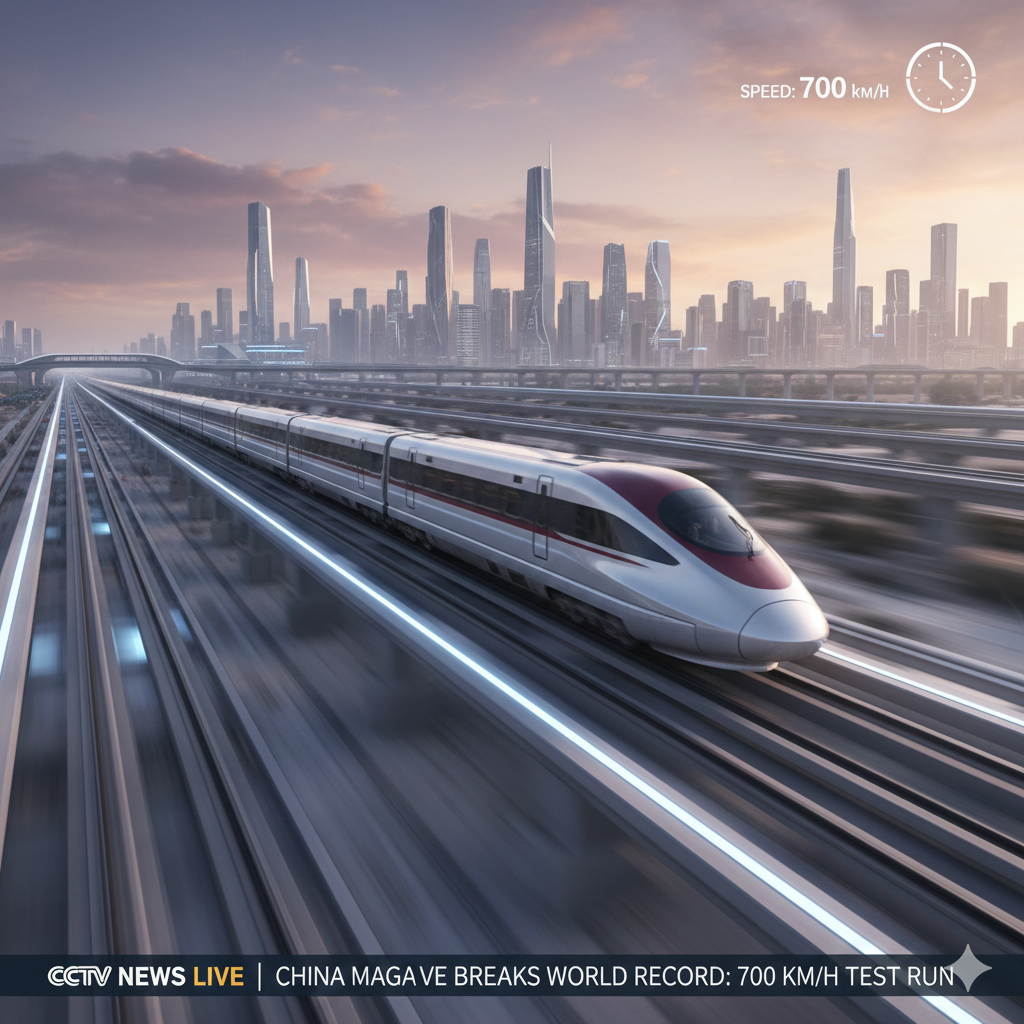
BEIJING, CHINA – December 27, 2025 – China has once again pushed the boundaries of high-speed rail, reportedly breaking a world speed record during the test run of its latest prototype magnetic levitation (maglev) train. The state-of-the-art train achieved a staggering 700 kilometers per hour (approximately 435 mph) on a dedicated test track, heralding a new era of ultra-fast ground transportation.
The milestone was confirmed by China Railway Rolling Stock Corporation (CRRC), the nation’s largest train manufacturer, following successful trials at a specialized maglev testing facility in Shandong Province. While details remain somewhat under wraps, the achievement underscores China’s ambition to lead the world in advanced transportation technology.
Leapfrogging Current Records
The new 700 km/h speed surpasses previous operational maglev trains, including China’s own Shanghai Maglev (which operates at a maximum of 431 km/h) and Japan’s experimental L0 Series, which holds the manned speed record at 603 km/h but is still under development.
-
Electromagnetic Power: The train utilizes powerful electromagnets to suspend itself above the track, eliminating friction and allowing for unprecedented speeds with minimal noise and vibration.
-
Aerodynamic Design: Engineers highlighted the train’s sleek, aerodynamic design, which minimizes air resistance—the primary barrier to achieving such speeds. The nose cone alone reportedly extends over 15 meters.
-
Safety & Efficiency: CRRC emphasized that safety protocols were rigorously followed during testing, and future commercial operation would focus on energy efficiency and integration into existing transport networks.
The Vision for “Super-Cities”
This new generation of maglev technology is central to China’s “super-city cluster” development strategy. By drastically cutting travel times between major urban centers, maglev trains are expected to:
-
Connect Megacities: Enable seamless travel between distant metropolitan areas like Beijing-Shanghai or Chengdu-Chongqing in a fraction of current journey times, effectively creating vast, interconnected economic zones.
-
Reduce Air Travel: Offer a viable alternative to short-haul flights, potentially easing air traffic congestion and reducing carbon emissions.
-
Economic Impact: Stimulate regional economic growth by facilitating faster movement of people and goods, attracting investment, and fostering innovation.
Global Race for High-Speed Domination
China’s latest achievement intensifies the global race for high-speed rail dominance. Japan continues development of its own maglev network, while countries in Europe and North America are exploring next-generation rail technologies.
The 700 km/h prototype is not expected to enter commercial service immediately, as further testing and infrastructure development will be required. However, its successful demonstration marks a significant leap forward, signaling China’s intent to reshape the future of transportation and potentially redefine how we conceive of long-distance travel on land.
700 701 702 703 704 705 706 707 708 709 710 711 712 713 714 715 716 717 718 719 720 721 722 723 724 725 726 727 728 729 730 731 732 733 734 735 736 737 738 739 740 741 742 743 744 745 746 747 748 749 750 751 752 753 754 755 756 757 758 759 760 761 762 763 764 765 766 767 768 769 770 771 772 773 774 775 776 777 778 779 780 781 782 783 784 785 786 787 788 789 790 791 792 793 794 795 796 797 798 799 800 801 802 803 804 805 806 807 808 809 810 811 812 813 814 815 816 817 818 819 820 821 822