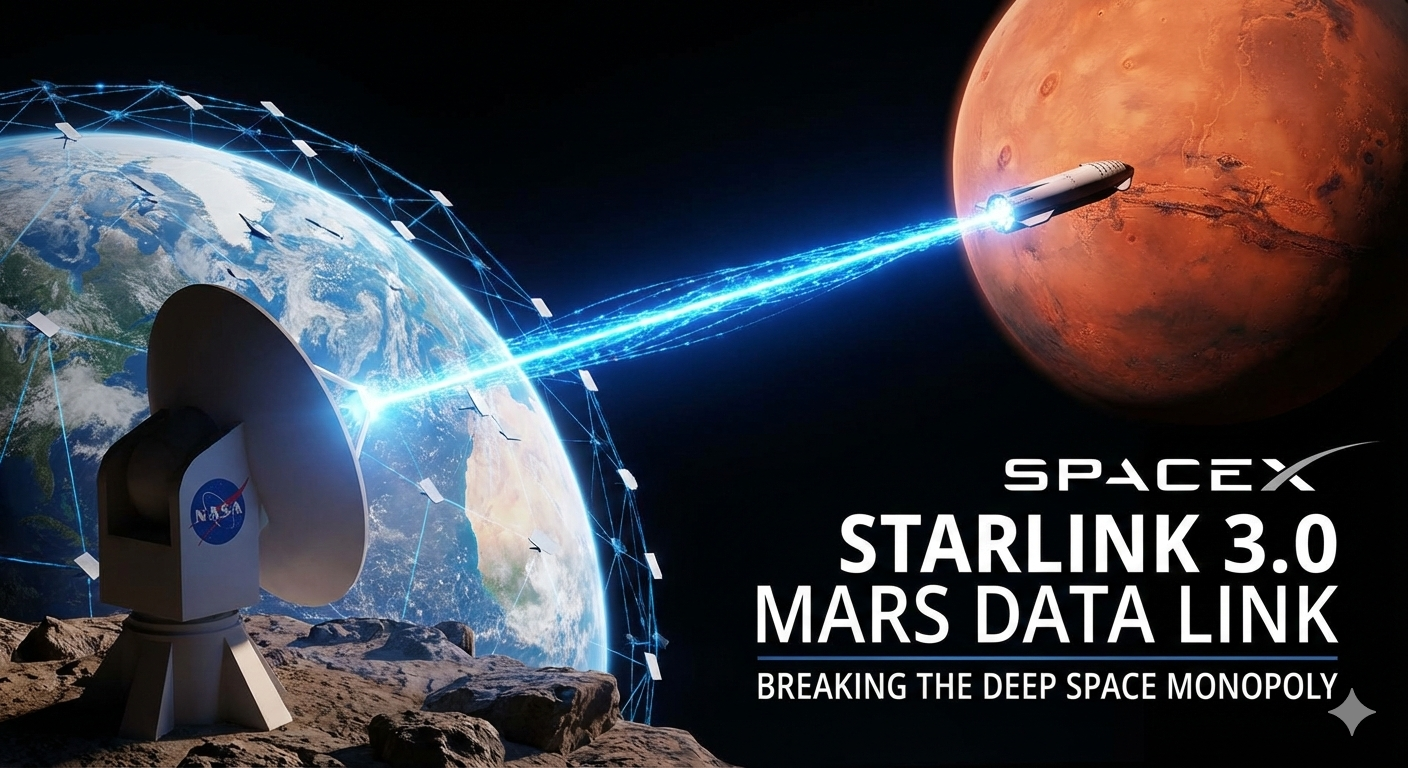
HAWTHORNE, CA – January 26, 2026 – In a landmark achievement for commercial spaceflight, SpaceX confirmed today that its advanced Starlink 3.0 satellite constellation successfully successfully facilitated a high-bandwidth data relay for a commercial Starship spacecraft currently on a trajectory for a Mars flyby. This event marks a significant turning point in space exploration, representing the first time a private infrastructure has handled deep-space communications, a domain traditionally reserved for government entities like NASA’s Deep Space Network (DSN).
A New Era of Deep Space Connectivity
The successful data link demonstrates the unprecedented capabilities of the Starlink 3.0 constellation. Unlike its predecessors, which were primarily designed for low-Earth orbit (LEO) internet service, the V3 satellites are equipped with significantly enhanced capabilities, including optical intersatellite links (space lasers) and more powerful antennas. These upgrades allow for high-speed data transfer over vast interplanetary distances.
“This is a game-changer,” said a SpaceX spokesperson. “We are no longer reliant solely on government-funded networks for deep space communication. Starlink 3.0 provides a robust, scalable, and commercially viable alternative that will accelerate humanity’s expansion into the solar system.”
Details of the Achievement
-
The Mission: A uncrewed commercial Starship, launched earlier this month as a pathfinder for future crewed Mars missions, is currently on a six-month journey for a Mars flyby.
-
The Link: Starlink 3.0 satellites in LEO established a high-bandwidth optical link with the Starship. This link allowed for the transmission of high-definition video, telemetry data, and other critical information back to Earth in near real-time.
-
The Bandwidth: While specific data rates were not disclosed, SpaceX confirmed that the link provided “multi-gigabit per second” connectivity, a massive leap over traditional deep-space radio communications which often suffer from significant latency and bandwidth limitations.
Implications for the Future
This achievement has profound implications for the future of space exploration:
-
Commercial Deep Space Missions: The availability of a private deep space communications network removes a major barrier for commercial companies looking to conduct missions beyond Earth orbit, such as asteroid mining, lunar resource utilization, and interplanetary tourism.
-
Reduced Reliance on NASA’s DSN: NASA’s aging DSN is often oversubscribed, leading to scheduling conflicts and limited communication windows for scientific missions. A commercial alternative like Starlink could alleviate this pressure, allowing the DSN to focus on its primary mission of supporting critical NASA science and exploration objectives.
-
Enabling a Multi-Planetary Future: High-bandwidth communication is essential for establishing a sustainable human presence on Mars and beyond. Starlink 3.0’s proven capability is a critical building block for Elon Musk’s vision of a self-sustaining city on the Red Planet.
-
Enhanced Scientific Data Return: Future scientific missions equipped with compatible optical terminals will be able to return vastly more data from across the solar system, accelerating scientific discovery.
Challenges Remain
Despite this success, significant challenges remain for a fully-fledged interplanetary internet. The distance to Mars introduces unavoidable light-speed delays, which can range from 3 to 22 minutes depending on the relative positions of Earth and Mars. Maintaining high-bandwidth links over such distances also requires precise pointing and tracking.
However, SpaceX’s achievement is a massive step forward. As the company continues to deploy its Starlink 3.0 constellation and refine its technology, the dream of a connected solar system is closer than ever to becoming a reality.
For a deeper dive into SpaceX’s Mars plans and the role of Starship, check out this video: Five SpaceX Starships to Mars in 2026 with thousands of Teslabots – YouTube. This video provides more context on the ambitious timeline and goals that this new communications capability will support.
700 701 702 703 704 705 706 707 708 709 710 711 712 713 714 715 716 717 718 719 720 721 722 723 724 725 726 727 728 729 730 731 732 733 734 735 736 737 738 739 740 741 742 743 744 745 746 747 748 749 750 751 752 753 754 755 756 757 758 759 760 761 762 763 764 765 766 767 768 769 770 771 772 773 774 775 776 777 778 779 780 781 782 783 784 785 786 787 788 789 790 791 792 793 794 795 796 797 798 799 800 801 802 803 804 805 806 807 808 809 810 811 812 813 814 815 816 817 818 819 820 821 822