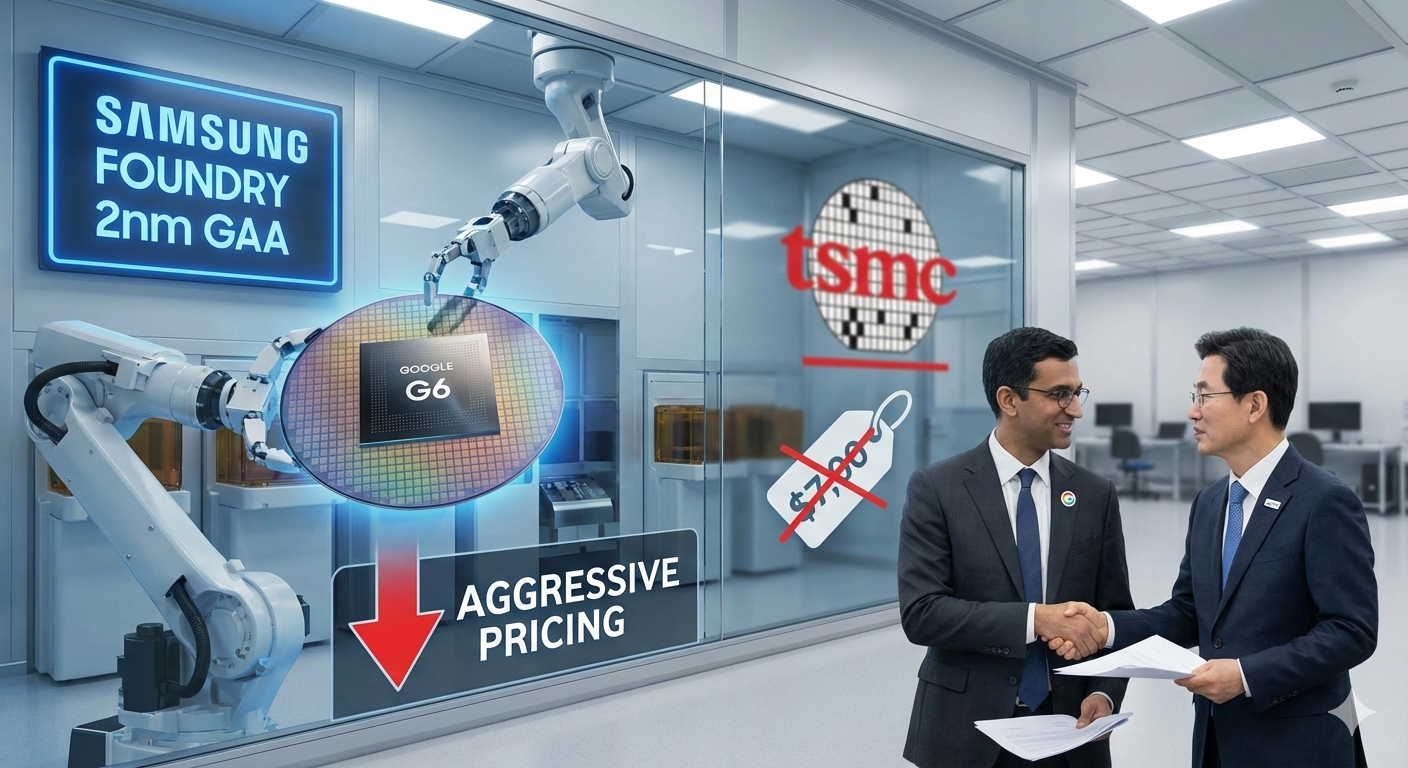
SEOUL / MOUNTAIN VIEW – February 13, 2026 – In a seismic shift for the global semiconductor industry, Google has reportedly selected Samsung Foundry as the exclusive manufacturing partner for its next-generation Tensor G6 system-on-a-chip (SoC). The multi-year deal, slated for the Pixel 11 series of devices, will see the chips built on Samsung’s cutting-edge 2nm process technology.
This strategic victory for Samsung marks a significant turning point in the “foundry war,” as the Korean giant has successfully managed to chip away at the long-standing dominance of Taiwan Semiconductor Manufacturing Company (TSMC) at the leading edge of chip fabrication.
The Power of GAA and Aggressive Pricing
According to industry sources, Samsung’s success in securing the lucrative Google contract stems from a two-pronged approach: superior yields in its Gate-All-Around (GAA) transistor architecture and a highly aggressive pricing strategy.
Samsung was the first foundry to implement GAA technology, which it calls Multi-Bridge Channel FET (MBCFET), at its 3nm node. While initial yields were reportedly challenging, this early adoption gave Samsung a crucial head start in maturing the complex manufacturing process. In contrast, TSMC is only just transitioning to GAA for its 2nm node, having stuck with the older FinFET architecture for its 3nm chips.
“Samsung’s gamble on early GAA adoption at 3nm is finally paying off,” said Horace Kwan, a senior semiconductor analyst at TechInsights. “They have had several years to debug the process and improve yields. When it came to 2nm, they were able to offer Google a more mature, higher-yielding process than TSMC’s initial 2nm offerings, and at a price point that TSMC simply wasn’t willing to match.”
Sources indicate that Samsung’s per-wafer price for its 2nm process was significantly lower than TSMC’s, a factor that likely proved irresistible to Google as it seeks to improve the margins on its Pixel hardware division.
A Blow to TSMC’s Dominance
For years, TSMC has been the undisputed king of advanced chip manufacturing, counting Apple, Nvidia, Qualcomm, and MediaTek among its primary clients. Google’s defection to Samsung for its flagship mobile chip is a notable dent in TSMC’s armor.
While TSMC is expected to retain Apple as the primary customer for its initial 2nm capacity, the loss of Google to a major rival raises questions about the pricing and yield ramp-up of its own N2 process. It also signals to the rest of the industry that Samsung is now a viable and competitive alternative at the absolute bleeding edge of technology.
“This is a wake-up call for TSMC,” added Kwan. “They can no longer take their market leadership for granted. Samsung has proven it can compete on both technology and price, and this could encourage other major players to reconsider their foundry partnerships.”
Implications for Google and the Pixel
For Google, partnering with Samsung for the Tensor G6 offers several potential benefits beyond cost savings. It could allow for deeper collaboration on chip design, potentially leading to a more customized and optimized SoC for future Pixel phones. Furthermore, diversifying its supply chain reduces reliance on a single manufacturer, a strategic move in an era of geopolitical uncertainty affecting the chip industry.
The Tensor G6, expected to debut in late 2026 or early 2027, will likely be one of the first consumer devices to showcase the capabilities of 2nm technology, promising significant gains in performance and energy efficiency over current-generation chips.
As the race for 2nm supremacy heats up, with Intel Foundry Services also making a strong push, the semiconductor landscape is becoming more competitive than ever. Samsung’s victory with Google is a clear declaration that the “foundry war” is far from over.
700 701 702 703 704 705 706 707 708 709 710 711 712 713 714 715 716 717 718 719 720 721 722 723 724 725 726 727 728 729 730 731 732 733 734 735 736 737 738 739 740 741 742 743 744 745 746 747 748 749 750 751 752 753 754 755 756 757 758 759 760 761 762 763 764 765 766 767 768 769 770 771 772 773 774 775 776 777 778 779 780 781 782 783 784 785 786 787 788 789 790 791 792 793 794 795 796 797 798 799 800 801 802 803 804 805 806 807 808 809 810 811 812 813 814 815 816 817 818 819 820 821 822