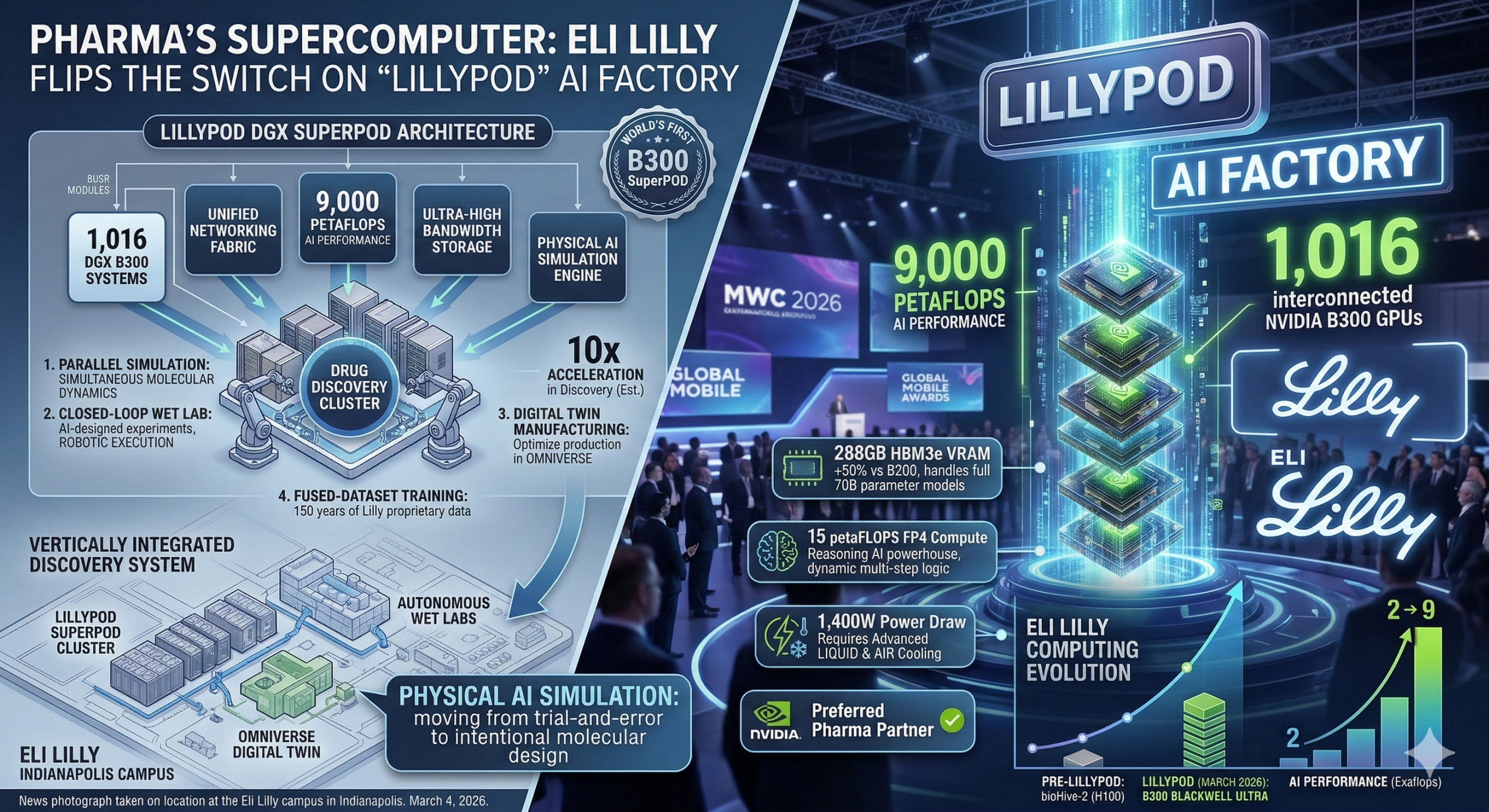
INDIANAPOLIS — March 4, 2026 — Pharmaceutical giant Eli Lilly has officially inaugurated LillyPod, the world’s most powerful AI supercomputer wholly owned and operated by a drug company. Built in partnership with NVIDIA, LillyPod is the first DGX SuperPOD to be powered entirely by the new Blackwell Ultra (B300) architecture, marking a $1 billion bet on the future of “Physical AI” in medicine.
The system, which went live this week at Lilly’s Indianapolis campus, delivers a staggering 9,000 petaflops of AI performance. To put that in perspective, a single GPU in the LillyPod cluster contains the computational power of approximately 7 million Cray supercomputers from the 1990s.
The “Physical AI” Revolution: Beyond Digital Chat
While most of the world associates AI with text generation, LillyPod is designed for Physical AI—systems that understand and simulate the laws of physics and biology to interact with the real world.
-
Molecular Dynamics at Scale: Lilly researchers are using the B300’s massive memory to run “high-fidelity” simulations of how a drug candidate binds to a protein in the human body. This “dry lab” approach allows scientists to test billions of molecular hypotheses in silico before ever touching a petri dish.
-
Continuous Learning Loops: LillyPod is the centerpiece of a “closed-loop” system. It connects to autonomous agentic wet labs where robotic arms execute experiments designed by the AI. The results are instantly fed back into the supercomputer to refine the next round of testing, creating a 24/7 discovery cycle.
-
Manufacturing Digital Twins: Beyond discovery, the system creates digital twins of Lilly’s manufacturing lines. Using the NVIDIA Omniverse platform, engineers can stress-test supply chains and optimize production for high-demand medications without pausing real-world factory operations.
Benchmarking the “LillyPod”
The deployment of 1,016 Blackwell Ultra GPUs places Eli Lilly at the top of the pharmaceutical computing hierarchy, surpassing the previous record-holder, Recursion’s BioHive-2.
| Metric | Previous Record (BioHive-2) | LillyPod (2026) |
| GPU Model | NVIDIA H100 | NVIDIA B300 (Blackwell Ultra) |
| GPU Count | 504 | 1,016 |
| AI Performance | ~2 Exaflops | ~9 Exaflops |
| Primary Use | Imaging & Genomics | Physical AI & Molecular Simulation |
Escaping the 10-Year Lifecycle
The ultimate goal of LillyPod is to break the “Eroom’s Law” of the pharmaceutical industry—the trend where drug discovery becomes slower and more expensive over time.
“We aren’t just looking to speed up research; we are looking to fundamentally change the timeline of human health,” said Thomas Fuchs, Chief AI Officer at Lilly. By automating the most tedious parts of the discovery phase and optimizing clinical trial enrollment through AI, Lilly hopes to cut the traditional 10-year development cycle down to just five years.
Lilly has also launched TuneLab, a federated AI platform that allows smaller biotech startups to access LillyPod’s proprietary models (trained on 150 years of Lilly data) without compromising their own intellectual property.
700 701 702 703 704 705 706 707 708 709 710 711 712 713 714 715 716 717 718 719 720 721 722 723 724 725 726 727 728 729 730 731 732 733 734 735 736 737 738 739 740 741 742 743 744 745 746 747 748 749 750 751 752 753 754 755 756 757 758 759 760 761 762 763 764 765 766 767 768 769 770 771 772 773 774 775 776 777 778 779 780 781 782 783 784 785 786 787 788 789 790 791 792 793 794 795 796 797 798 799 800 801 802 803 804 805 806 807 808 809 810 811 812 813 814 815 816 817 818 819 820 821 822