PASADENA, CA – December 27, 2025 – In a discovery hailed as a “monumental leap” for human space exploration, scientists at NASA’s Jet Propulsion Laboratory (JPL) have announced the identification of a new, vast region on Mars where significant deposits of water ice are buried less than a meter beneath the surface. This accessible reservoir of frozen water is being described as a “game-changer” for future human landings, offering a critical resource for long-duration missions.
The findings, published today in Science Advances, are the result of advanced radar imaging from the Mars Reconnaissance Orbiter (MRO) and refined data analysis from previous missions like Mars Odyssey.
The “Ice Highway” Region
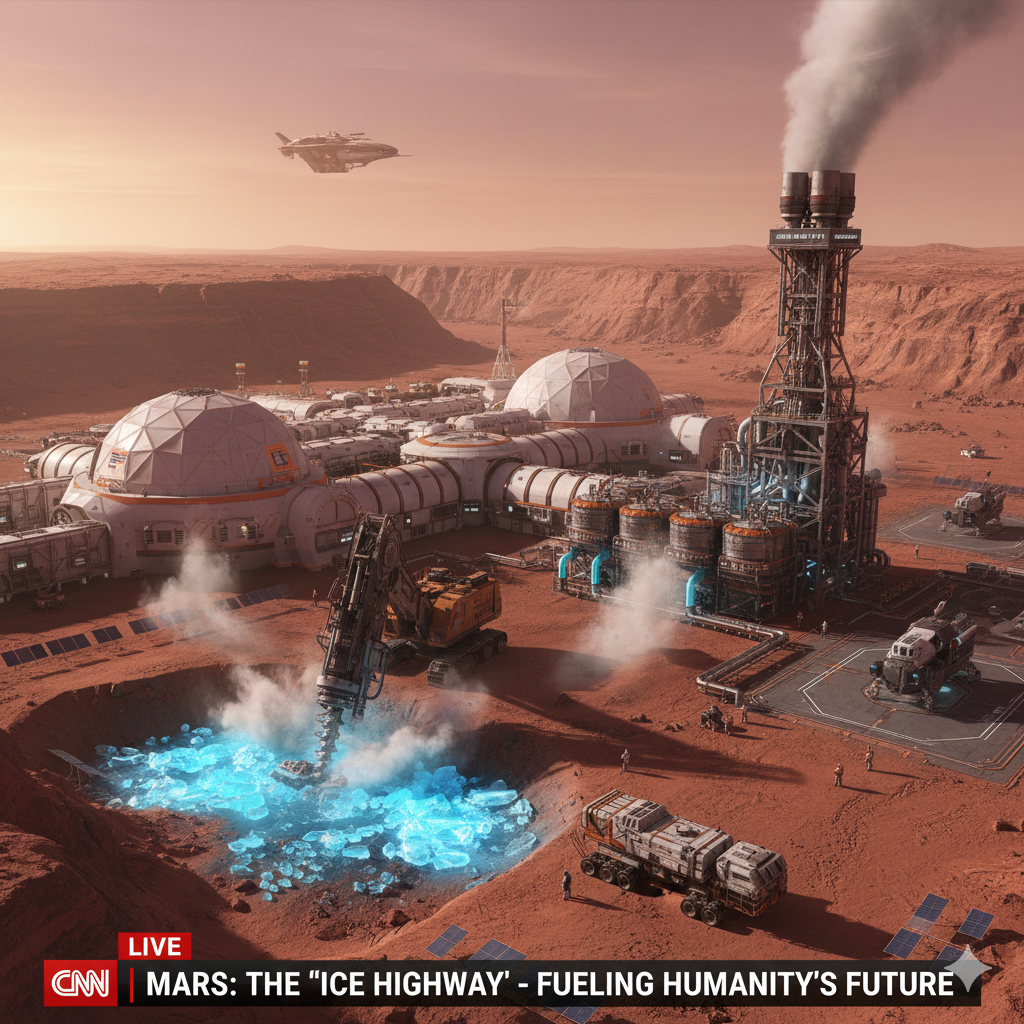
The newly identified region, dubbed the “Ice Highway”, is located in the mid-latitudes of Mars, specifically within the Arcadian Planitia. Unlike previous discoveries of subsurface ice, which were often deeper or in more extreme polar regions, this new site offers unprecedented accessibility.
-
Shallow Depth: The ice sheet begins at an average depth of 80 centimeters (just under 3 feet), making it reachable with existing or near-future excavation technologies.
-
Vast Extent: Preliminary estimates suggest the deposits are extensive, potentially covering an area equivalent to the size of Texas, with ice layers several meters thick in places.
-
Prime Landing Zone: Its mid-latitude location is crucial, offering more moderate temperatures and better solar power generation opportunities compared to the harsh poles, making it a highly attractive candidate for future human landing sites.
Fueling the Future: ISRU
The significance of this discovery lies in its potential for In-Situ Resource Utilization (ISRU). For human missions to Mars, carrying all necessary supplies from Earth is prohibitively expensive and logistically complex. The ability to “live off the land” by utilizing local resources is paramount.
-
Drinking Water: The most immediate benefit is a readily available source of potable water for astronauts.
-
Oxygen Generation: Water (H₂O) can be electrolyzed to produce oxygen for breathing, crucial for self-sustaining habitats.
-
Rocket Fuel: Both hydrogen and oxygen are key components of rocket propellants. Producing fuel on Mars would enable return journeys to Earth or further exploration of the solar system without resupply missions.
“This isn’t just about finding water; it’s about finding freedom,” stated Dr. Lena Hansen, lead author of the study and a planetary scientist at JPL. “Every kilogram of water or fuel we don’t have to launch from Earth dramatically reduces the cost and risk of sending humans to Mars. This ‘Ice Highway’ makes that dream so much more tangible.”
Accelerating Martian Ambitions
NASA and its international partners have already begun re-evaluating potential landing sites for the upcoming Artemis III Mars-precursor mission and subsequent human landings. The focus will now shift to detailed reconnaissance of the “Ice Highway” region to identify the most optimal extraction points.
This discovery moves humanity one significant step closer to establishing a sustained presence on the Red Planet, transforming science fiction into an increasingly achievable reality.
700 701 702 703 704 705 706 707 708 709 710 711 712 713 714 715 716 717 718 719 720 721 722 723 724 725 726 727 728 729 730 731 732 733 734 735 736 737 738 739 740 741 742 743 744 745 746 747 748 749 750 751 752 753 754 755 756 757 758 759 760 761 762 763 764 765 766 767 768 769 770 771 772 773 774 775 776 777 778 779 780 781 782 783 784 785 786 787 788 789 790 791 792 793 794 795 796 797 798 799 800 801 802 803 804 805 806 807 808 809 810 811 812 813 814 815 816 817 818 819 820 821 822