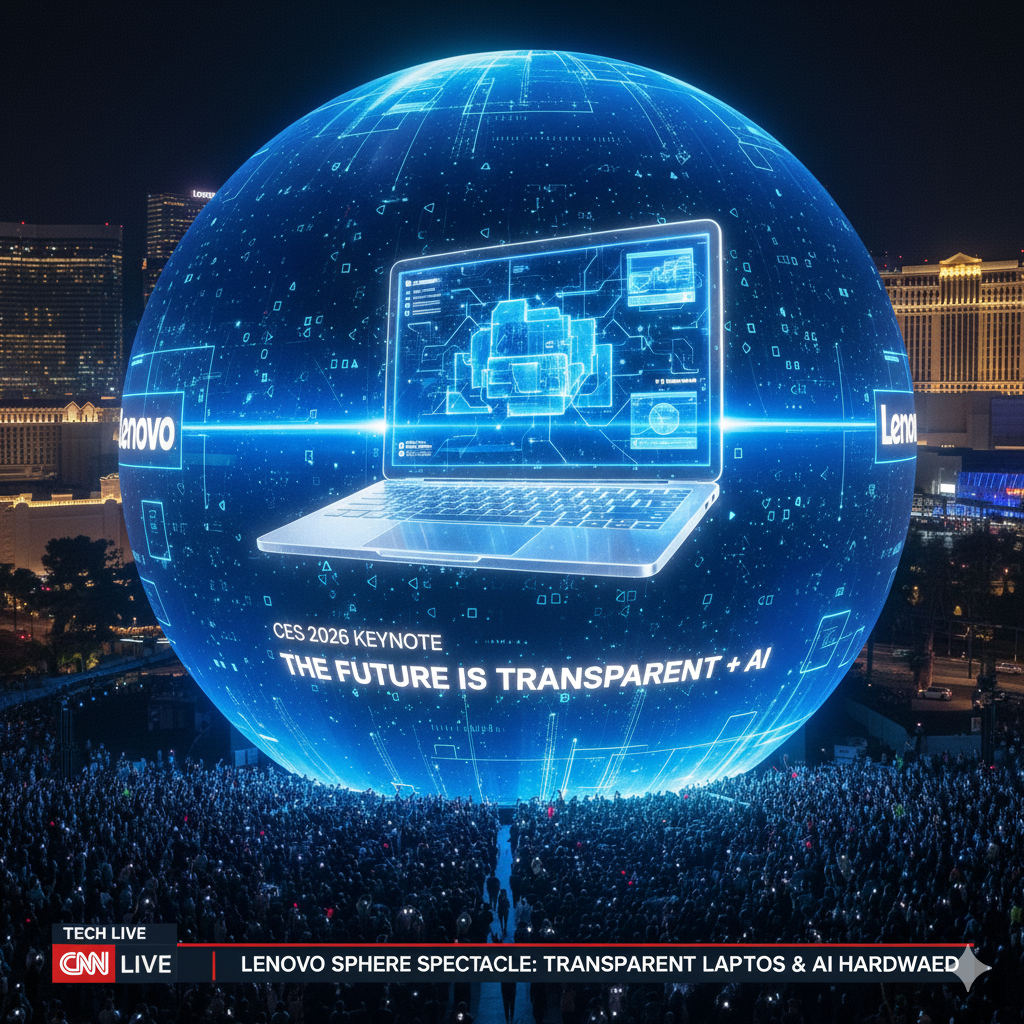
LAS VEGAS, NV – January 12, 2026 – Lenovo’s “Tech World” keynote at the Las Vegas Sphere has officially become the most talked-about event of CES 2026. By utilizing the world’s most advanced immersive venue, Lenovo didn’t just show off hardware; they projected a holographic vision of the future. The star of the show was the commercial debut of the ThinkBook Transparent Display Laptop, a device that literally lets you see through the screen while working in a high-definition digital layer.
While the “Auto Twist” motorized laptop and the “Legion Rollable” were also on display, it was the transparent Micro-LED technology that stole the spotlight, signaling a new era for augmented reality (AR) in professional workflows.
1. The Hardware: “See-Through” Micro-LED
The ThinkBook Transparent Display Laptop is no longer just a proof-of-concept. The commercial version features a 17.3-inch borderless Micro-LED screen with up to 55% transparency.
-
Luminance and Clarity: Unlike previous transparent OLED prototypes that were dim and blurry, Lenovo’s Micro-LED panel hits a staggering 1,000 nits of peak brightness, making it usable even in well-lit office environments.
-
Privacy Mode: A major concern—privacy—has been addressed with a “blackout” filter layer. With a single click, the glass can shift from transparent to nearly opaque, ensuring that people sitting across from you can’t read your sensitive documents.
-
The “Floating” Deck: The keyboard is a flat, touch-sensitive glass surface that doubles as a giant Wacom-style drawing tablet. When not in use, the keys fade away, leaving a completely clear glass slab that feels like something out of Minority Report.
2. AI-Native Integration: “Qira” and Spatial Awareness
Lenovo’s new personal AI assistant, Qira, is built into the core of the machine. At the Sphere, Lenovo demonstrated how Qira uses the laptop’s rear-facing cameras to “see” the physical world behind the screen.
-
Digital Overlays: If you place a physical object—like a circuit board or a blueprint—behind the screen, Qira identifies it and overlays digital schematics and real-time data onto the transparent display.
-
Object Recognition: In one demo, a designer placed a physical model of a building behind the screen; the laptop instantly projected a 3D digital “lighting simulation” over the physical model to show how shadows would fall at different times of day.
3. The “Sphere” Experience
The venue itself played a crucial role. Lenovo utilized the Sphere’s Exosphere (the outer LED shell) to display a massive 3D version of the laptop, making it look as though a giant transparent screen was floating over the Las Vegas Strip.
-
Spatial Audio: Inside, the keynote used the Sphere’s 167,000 speakers to create “AI-localized” sound. As the transparent laptop “moved” across the giant screens, the audio tracked perfectly with it, creating a truly immersive look at the future of “spatial computing.”
4. Pricing and Availability
The ThinkBook Transparent Display Laptop is being positioned as a premium tool for architects, industrial designers, and medical professionals.
-
Release Date: Expected to ship in Q3 2026.
-
Estimated Price: While not officially confirmed, insiders suggest a “Early Adopter” price point of approximately $4,499, reflecting the high cost of the specialized Micro-LED panels.
700 701 702 703 704 705 706 707 708 709 710 711 712 713 714 715 716 717 718 719 720 721 722 723 724 725 726 727 728 729 730 731 732 733 734 735 736 737 738 739 740 741 742 743 744 745 746 747 748 749 750 751 752 753 754 755 756 757 758 759 760 761 762 763 764 765 766 767 768 769 770 771 772 773 774 775 776 777 778 779 780 781 782 783 784 785 786 787 788 789 790 791 792 793 794 795 796 797 798 799 800 801 802 803 804 805 806 807 808 809 810 811 812 813 814 815 816 817 818 819 820 821 822