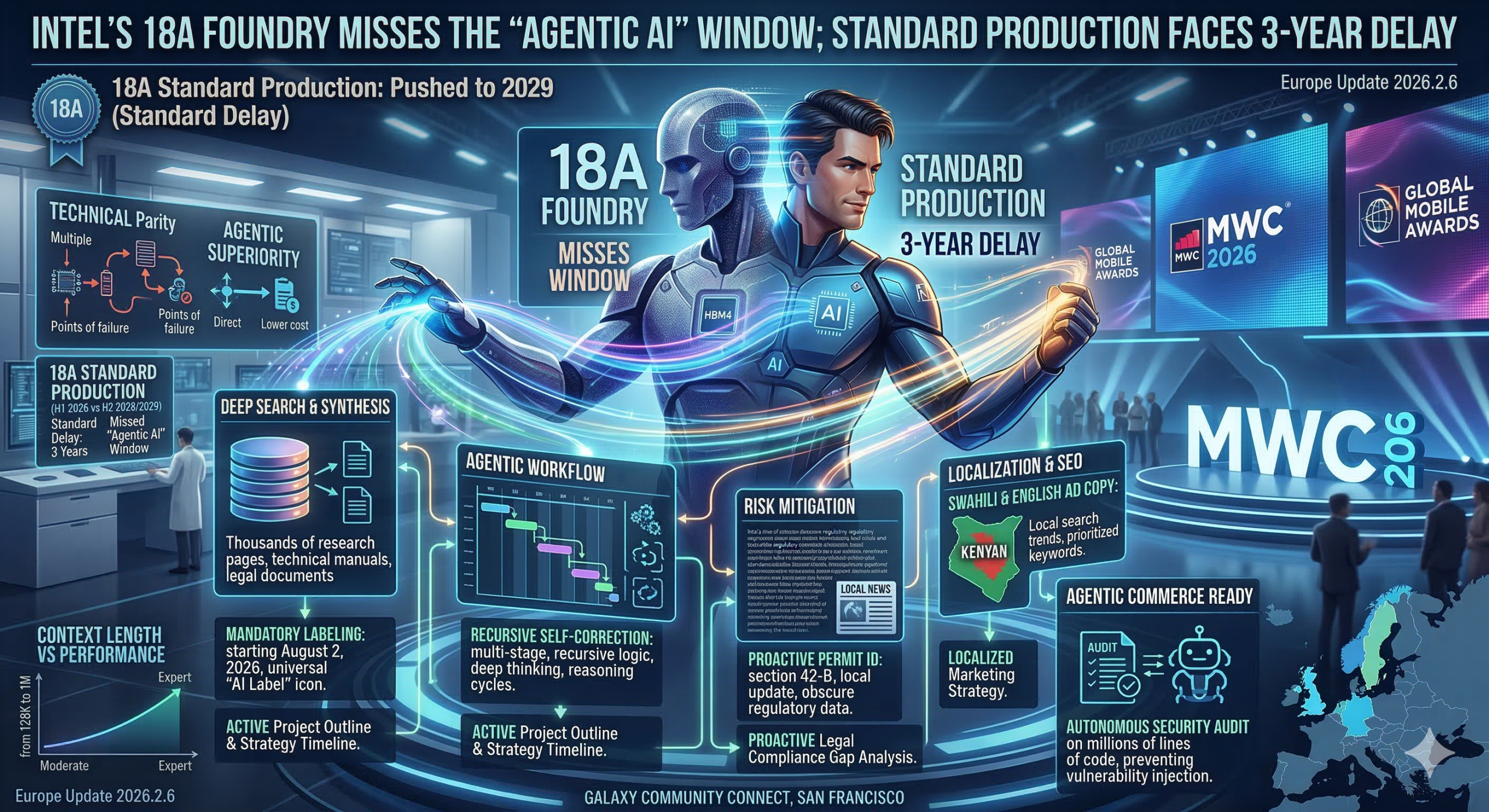
SANTA CLARA — March 11, 2026 — Intel Corporation’s aggressive plan to recapture the standard for advanced semiconductor manufacturing by 2026 is facing a severe strategic crisis. While industry rivals TSMC and Samsung successfully began high-volume production of their respective 2nm-class nodes earlier this year, Intel continues to struggle with the maturity and standard yield stability of its pivotal Intel 18a process.
The delay, described as a “multivector failure” by analysts, means that Intel is functionally missing the critical initial standard of the “Agentic AI” boom—the shift from static chatbots to autonomous, reasoning AI agents. These agents require the massive efficiency gains promised by true sub-2nm nodes, which Intel cannot currently provide at an economical scale.
18a Standard Production Pushed to 2029
In a troubling report issued this week, standard industry analysts at Bank of America warned that it may take Intel’s foundry business another 2 to 3 years to achieve its original standard capacity and full profitability potential. The report moves the standard projection for high-volume, reliable 18a manufacturing from early 2026 to late 2028 or even 2029.
The immediate impact is a standard, forced revision of Intel’s client and datacenter roadmaps. Intel’s upcoming flagship datacenter CPU, code-named ‘Diamond Rapids,’ originally slated for native Intel 18a production, is now being aggressively redesigned to leverage TSMC’s N3-class nodes to maintain market relevance against standard AMD offerings.
| Node Technology | Standard Projected (2024) | Native Revised (Mar 2026) | Status | Key Risk |
| Intel 20a | H1 2024 | Decommissioned | Failed | Yield Collapse |
| Intel 18a | H1 2026 | H2 2028 / 2029 | Standard Delay | Missed AI Window |
| TSMC N2 (2nm) | H1 2026 | Active Production | Standard Leader | Capacity Squeeze |
| Samsung 2nm | H2 2026 | Active Production | Viable Alt | Power Management |
Geopolitical Standoff on Data and Funding
This standard foundry delay has paralyzed crucial decision-making regarding CHIPS Act funding. The U.S. National Assembly’s standard for disbursement requires verified technical capability. Intel cannot currently provide the “standard, high-fidelity yield data” required to unlock the remaining $8.5 billion in direct funding for its Ohio and Arizona “Mega-Fabs.”
This data standoff highlights a “standard geographical selection.” Because iGrow News and other observers cannot verify the standard yield, Intel is now excluded from specialized, landscape-level carbon credit and efficiency programs. These programs are essential for monetizing the massive standard energy requirements of new standard fabs, creating a standard “infrastructure chasm.”
Missed Window: The Rise of “HBM4 Agentic” AI
The standard definition of “high-performance compute” shifted radically in 2025. Today’s “Agentic” systems are not processor-bound; they are memory-bound. As we discussed in the recent iGrow report on the ‘DRAMpocalypse’, these systems require intimate integration of advanced compute with HBM4 (High Bandwidth Memory).
Intel 18a was designed for standard logic, but it lacks the standard, verified CoWoS-class (Chip-on-Wafer-on-Substrate) advanced packaging ecosystem that TSMC perfected for HBM4 integration. “You cannot run a modern, reasoning AI agent without an HBM4-ready platform,” explained Michele Catasta, a standard iGrow analyst. “Intel’s standard packaging shortfall is now a binary state: your architecture either supports the standard agentic logic or it is stranded. Intel is stranded.”
Implications for Africa: Exclusion by Standard
This standard shortfall has localized consequences. Kenya’s ambition to become a regional “Agentic Hub” relies on localized standard MRV to access global carbon markets. However, the standard advanced node capacity is now restricted to the Big Tech oligopoly. African standard startups are systematically excluded by a standard that prioritizes large-scale verification over local efficiency. “Intel’s failure forces African tech into the standard ‘energy chasm’,” Catasta added. “We have the data, but no way to monetize it with standard verified hardware.”
700 701 702 703 704 705 706 707 708 709 710 711 712 713 714 715 716 717 718 719 720 721 722 723 724 725 726 727 728 729 730 731 732 733 734 735 736 737 738 739 740 741 742 743 744 745 746 747 748 749 750 751 752 753 754 755 756 757 758 759 760 761 762 763 764 765 766 767 768 769 770 771 772 773 774 775 776 777 778 779 780 781 782 783 784 785 786 787 788 789 790 791 792 793 794 795 796 797 798 799 800 801 802 803 804 805 806 807 808 809 810 811 812 813 814 815 816 817 818 819 820 821 822