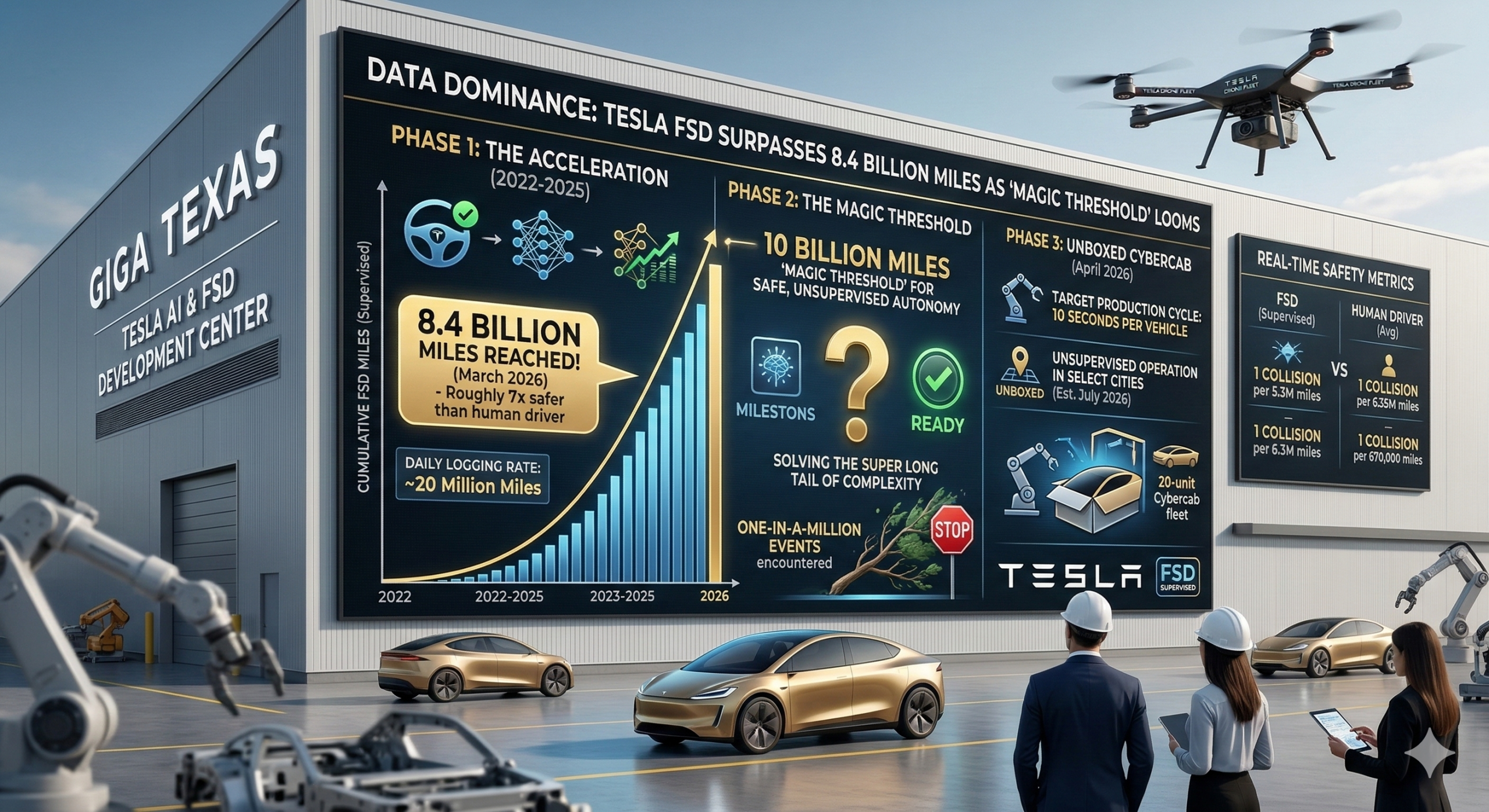
AUSTIN, TX — March 5, 2026 — Tesla has reached a critical milestone in its quest for vehicle autonomy, officially recording over 8.4 billion cumulative miles driven with its “Full Self-Driving (Supervised)” system. This achievement, confirmed on Tesla’s official safety page this week, places the company within striking distance of the 10-billion-mile “magic threshold” that CEO Elon Musk has identified as the requirement for safe, unsupervised driving.
The rate of data collection has reached an exponential fever pitch. While it took the company years to reach its first billion miles, Tesla owners are now logging an average of 20 million miles per day, effectively adding a new billion-mile layer to the neural network every 50 days.
The “10 Billion” Logic: Solving the Super Long Tail
Elon Musk’s recent pivot to a 10-billion-mile benchmark—up from his earlier estimate of 6 billion—reflects a maturing understanding of what he calls the “super long tail of complexity.”
In the world of AI training, the “head” of the distribution represents easy tasks: highway lane-keeping and stopping at traffic lights. The “long tail” represents the infinite, bizarre edge cases of reality—a storm-blown branch obscuring a stop sign, a construction worker using non-standard hand signals, or livestock crossing a city street.
“Reality has a super long tail of complexity,” Musk noted on X. “To achieve safe, unsupervised self-driving, the system must encounter these one-in-a-million events enough times to generalize a safe response that is statistically superior to a human.”
The Exponential Ramp-Up
| Year | Cumulative FSD Miles |
| 2022 | 80 Million |
| 2023 | 670 Million |
| 2024 | 2.25 Billion |
| 2025 | 7.25 Billion |
| March 2026 | 8.4 Billion |
Safety Metrics: The Human vs. Machine Gap
Alongside the mileage milestone, Tesla released updated safety data aimed at convincing regulators that its vision-only system is ready for the next level.
-
Collision Rates: Vehicles with FSD (Supervised) engaged currently record a serious collision once every 5.3 million miles.
-
The Comparison: For typical vehicles in the U.S., the average is one collision every 670,000 miles.
-
The Verdict: Based on these figures, Tesla argues that its supervised AI is already roughly seven times safer than the average human driver.
Cybercab: The Physical Manifestation of 8.4B Miles
The data milestone coincides with significant activity at Giga Texas, where the first Cybercab test units officially rolled off the line in late February.
Drone footage from March 4 captured a fleet of 25 Cybercabs—metallic gold, two-seater vehicles with no steering wheels or pedals—undergoing autonomous testing and crash validation. These vehicles represent the culmination of Tesla’s 8.4 billion miles of learning, designed to operate exclusively as unsupervised robotaxis.
Tesla is currently utilizing a revolutionary “unboxed” manufacturing process for the Cybercab, aiming for a production cycle of just 10 seconds per vehicle once mass production begins, which is currently slated for April 2026.
The Path to 10 Billion
At the current daily logging rate, Tesla is projected to hit the 10-billion-mile mark by July 2026. This summer milestone is expected to trigger a massive regulatory push from Tesla to allow “unsupervised” operation in select North American cities, potentially turning every compatible Tesla on the road into a revenue-generating asset for its owner.
700 701 702 703 704 705 706 707 708 709 710 711 712 713 714 715 716 717 718 719 720 721 722 723 724 725 726 727 728 729 730 731 732 733 734 735 736 737 738 739 740 741 742 743 744 745 746 747 748 749 750 751 752 753 754 755 756 757 758 759 760 761 762 763 764 765 766 767 768 769 770 771 772 773 774 775 776 777 778 779 780 781 782 783 784 785 786 787 788 789 790 791 792 793 794 795 796 797 798 799 800 801 802 803 804 805 806 807 808 809 810 811 812 813 814 815 816 817 818 819 820 821 822