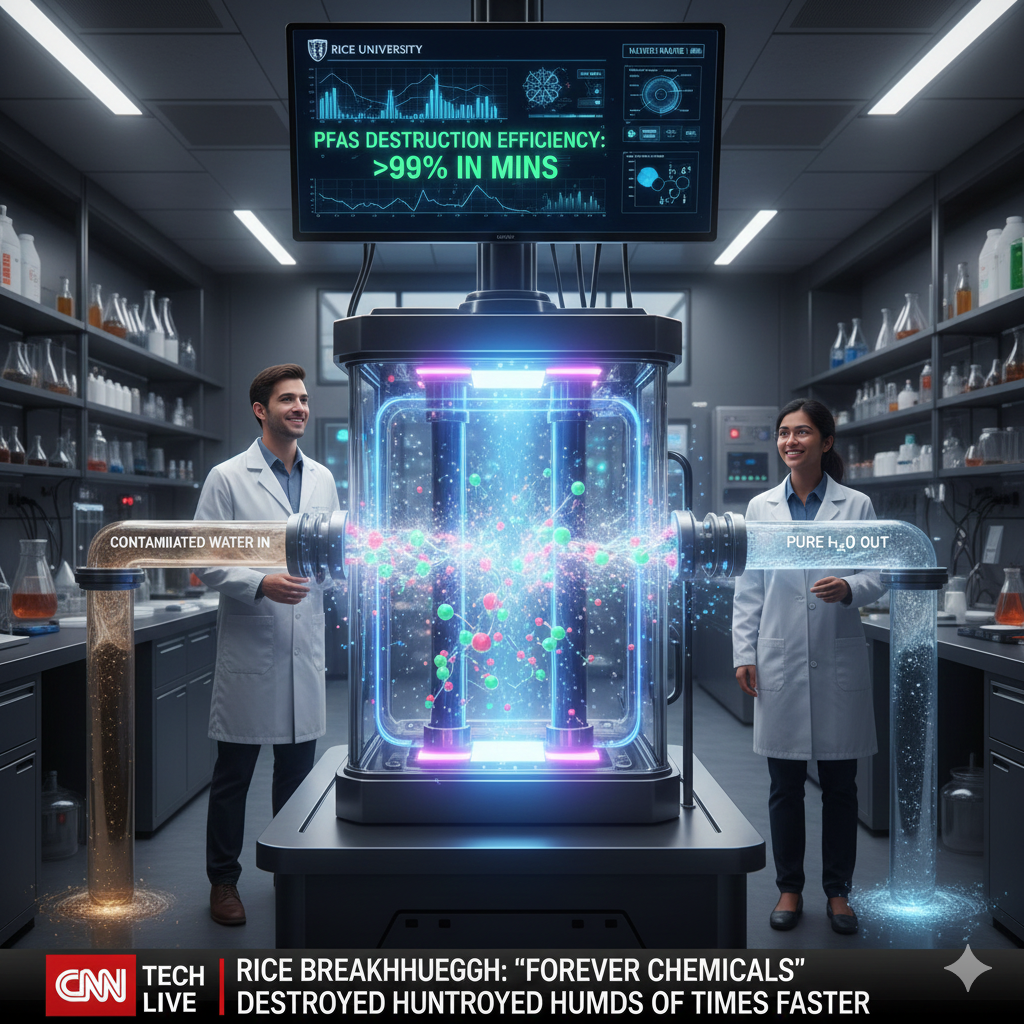
HOUSTON, TX – December 27, 2025 – In a major win for environmental science, researchers at Rice University have announced a revolutionary eco-friendly technology capable of capturing and destroying PFAS (per- and polyfluoroalkyl substances) in water hundreds of times faster than existing filtration methods. The breakthrough offers a critically needed solution to the pervasive problem of “forever chemicals” that contaminate drinking water sources globally.
The innovative system, detailed today in Nature Water, utilizes a novel electrochemical process that not only removes PFAS from water but also completely breaks down their resilient carbon-fluorine bonds, rendering them harmless.
The PFAS Problem: A Global Crisis
PFAS are a class of over 12,000 synthetic chemicals used in countless everyday products—from non-stick cookware and waterproof fabrics to firefighting foams and food packaging. Their strong carbon-fluorine bonds make them incredibly stable, leading to their moniker “forever chemicals” because they resist degradation in the environment and accumulate in human bodies. Exposure to PFAS has been linked to a range of health issues, including cancer, hormonal disruption, and immune system problems.
Existing methods for removing PFAS are often slow, energy-intensive, and primarily focus on filtration (which only concentrates the chemicals, requiring further disposal) rather than complete destruction.
Rice’s “Flash Electrochemistry” Solution
The Rice University team, led by Dr. Julian Chen and Professor Mason Bellweather, developed a “flash electrochemistry” system that leverages highly reactive radicals generated by specialized electrodes.
-
Rapid Destruction: The system can destroy over 99% of various PFAS compounds in water in a matter of minutes, a process that can take hours or even days with conventional methods.
-
Complete Breakdown: Unlike filters, this technology breaks the notoriously strong carbon-fluorine bonds, converting the toxic PFAS into harmless fluoride ions and carbon byproducts.
-
Eco-Friendly and Cost-Effective: The process requires no harsh chemicals, operates at room temperature, and boasts significantly lower energy consumption compared to high-temperature incineration or UV-based degradation methods. Its modular design also suggests scalability for diverse applications.
-
Versatile Application: The technology has shown effectiveness in treating various water sources, including industrial wastewater, municipal drinking water, and even highly contaminated groundwater.
“A New Hope for Clean Water”
“This is not just an incremental improvement; it’s a paradigm shift,” stated Dr. Chen at a press conference. “We’ve developed a technology that can effectively neutralize a contaminant that has plagued our planet for decades, doing so rapidly, cleanly, and at a scale that can truly make a difference.”
Professor Bellweather added, “Our goal was to create a solution that not only tackles the immediate threat but also offers a sustainable, long-term approach to eliminating PFAS from our environment. This technology represents a new hope for clean water globally.”
The research team is now working on scaling up the technology for pilot projects in collaboration with municipal water treatment plants and industrial partners, with the aim of commercial deployment within the next two to three years. The breakthrough could lead to cleaner drinking water, safer agricultural practices, and a healthier future free from the persistent threat of forever chemicals.
700 701 702 703 704 705 706 707 708 709 710 711 712 713 714 715 716 717 718 719 720 721 722 723 724 725 726 727 728 729 730 731 732 733 734 735 736 737 738 739 740 741 742 743 744 745 746 747 748 749 750 751 752 753 754 755 756 757 758 759 760 761 762 763 764 765 766 767 768 769 770 771 772 773 774 775 776 777 778 779 780 781 782 783 784 785 786 787 788 789 790 791 792 793 794 795 796 797 798 799 800 801 802 803 804 805 806 807 808 809 810 811 812 813 814 815 816 817 818 819 820 821 822