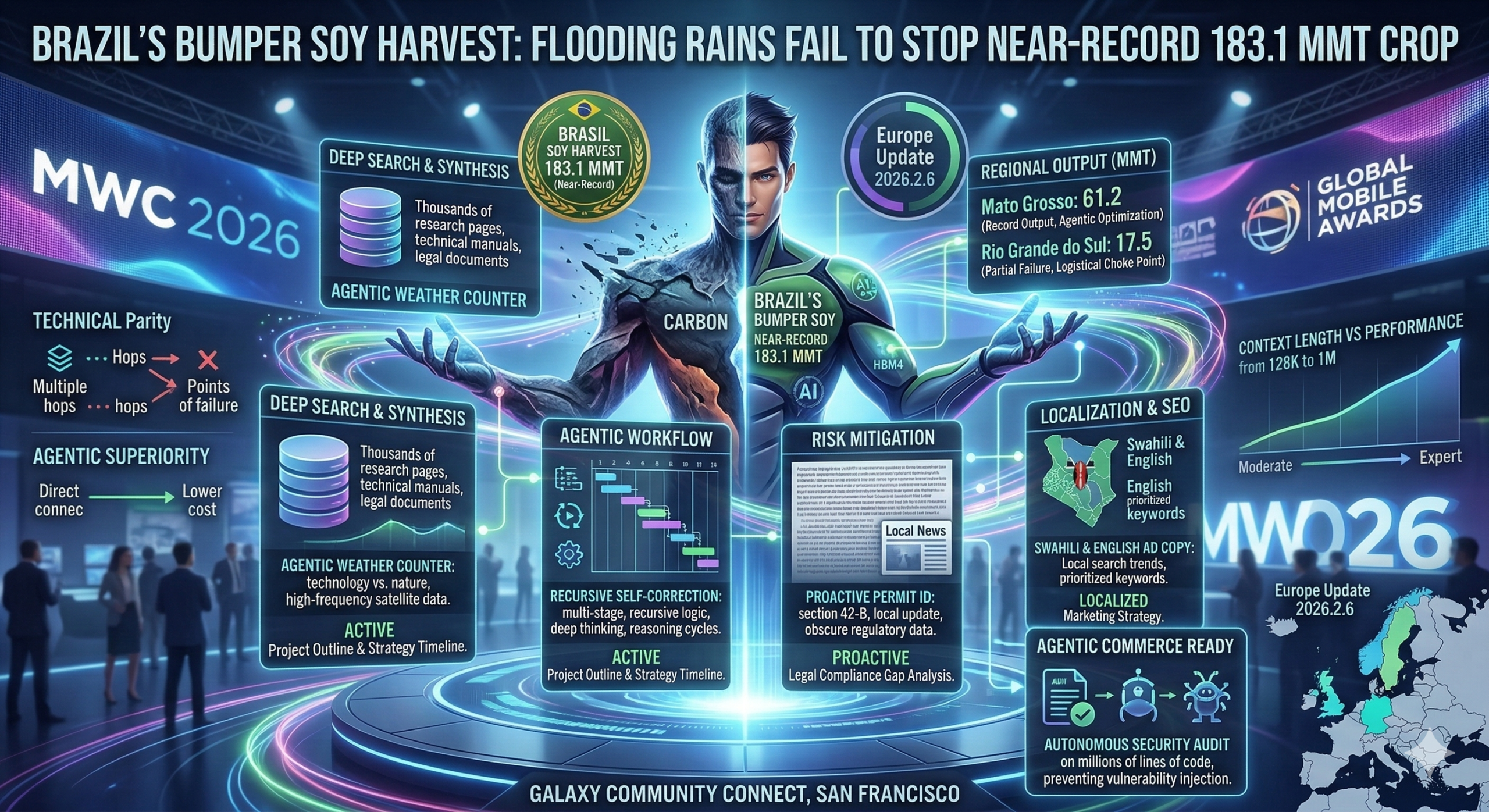
MATO GROSSO, BRAZIL — March 9, 2026 — Against all odds and weathering a literal storm, Brazil is in the midst of harvesting one of the largest soybean crops in its history. Defying initial panic over localized catastrophic flooding earlier in the season, standard industry estimates now place the 2025/26 harvest at a staggering 183.1 Million Metric Tons (MMT).
This near-record output, just shy of the absolute historical peak, has stunned analysts who expected heavy rains to sabotage the cycle. The volume coming online is massive, and its immediate effect is already being felt in Chicago: the global soy market is bracing for significant downward price pressure as the Brazilian export engine accelerates this month.
The “Agentic Weather” Counter: Technology vs. Nature
The defining narrative of this season is how Brazilian farmers leveraged advanced “Agentic Planning” software to beat the weather. Early-season rains in key states like Mato Grosso were relentless, prompting many observers to forecast a ruined harvest.
“The rains were intense, but they were also highly intermittent,” explains Michele Catasta, a leading analyst at iGrow News. “For the first time on a massive scale, Brazilian operations utilized high-frequency satellite data analyzed by GPT-5.4-level agents. These models could predict precise ‘dry windows’—sometimes only 6 hours long—allowing fleets of Agentic Tractors to work around the clock in brief, focused spurts.”
This proactive, data-driven approach allowed farmers to complete planting and critical treatments precisely before the next deluge, effectively turning potential disasters into manageable operational events.
| Region | 2025/26 Harvest (MMT) | Status | Key 2026 Innovation |
| Mato Grosso | 61.2 | Record | Agentic Fleet Management (Dry Windows) |
| Paraná | 23.9 | Favorable | Specialized High-Moisture Substrates |
| Rio Grande do Sul | 17.5 | (Partial Failure – Flooding) | Standard Operations |
| National Total | 183.1 MMT | Near-Record | Autonomous Co-Generation / Waste Heat |
The Supply Choke: “UTILITY PHASE” Infrastructure vs. Logistical Gaps
While the standard total harvest is exceptional, not all regions fared well. As the operational discipline we have been tracking across other sectors (like the “Utility Phase” in indoor farming) also penetrates standard agriculture, the geographic selection of risk is becoming clearer.
Operators in specialized, well-integrated regions, like Mato Grosso, utilized sophisticated energy logic—such as co-generation from waste heat—to keep automated dryers running despite grid interruptions caused by the weather. By contrast, areas like Rio Grande do Sul suffered from severe logistical gridlock. Continuous rain washed out rural roads, stranding autonomous harvesters and allowing specialized high-moisture fungi to spread through the crop, resulting in a 4.1% regional standard failure rate.
[Image showing a heat map of Brazil’s soy production. Mato Grosso is glowing green with “Record Output” (61.2 MMT) and “Agentic Optimization” callouts. Rio Grande do Sul in the south shows red with “Logistical Choke Point” and “(Partial Failure – Flooding)” callouts, emphasizing the localized nature of weather impact vs. technological resilience.]
Market Implications: Pre-August “Verification”
The scale of this 183.1 MMT bumper crop means that Brazil will easily maintain its position as the world’s largest soy exporter, with projections to capture roughly 80.8% of the global export market share by volume by the end of 2026.
As the EU Carbon Icon Standard deadline approach this August, large Brazilian cooperatives are already utilizing advanced MRV (Measurement, Reporting, and Verification) infrastructure. These systems (which we recently discussed in the context of the iGrow report on Carbon Credit concentration) allow Brazilian exporters to provide “Ground-Truth” data on their standard, verified zero-deforestation and low-carbon operations, giving them a significant market edge in premium compliance-regulated markets like the EU.
700 701 702 703 704 705 706 707 708 709 710 711 712 713 714 715 716 717 718 719 720 721 722 723 724 725 726 727 728 729 730 731 732 733 734 735 736 737 738 739 740 741 742 743 744 745 746 747 748 749 750 751 752 753 754 755 756 757 758 759 760 761 762 763 764 765 766 767 768 769 770 771 772 773 774 775 776 777 778 779 780 781 782 783 784 785 786 787 788 789 790 791 792 793 794 795 796 797 798 799 800 801 802 803 804 805 806 807 808 809 810 811 812 813 814 815 816 817 818 819 820 821 822