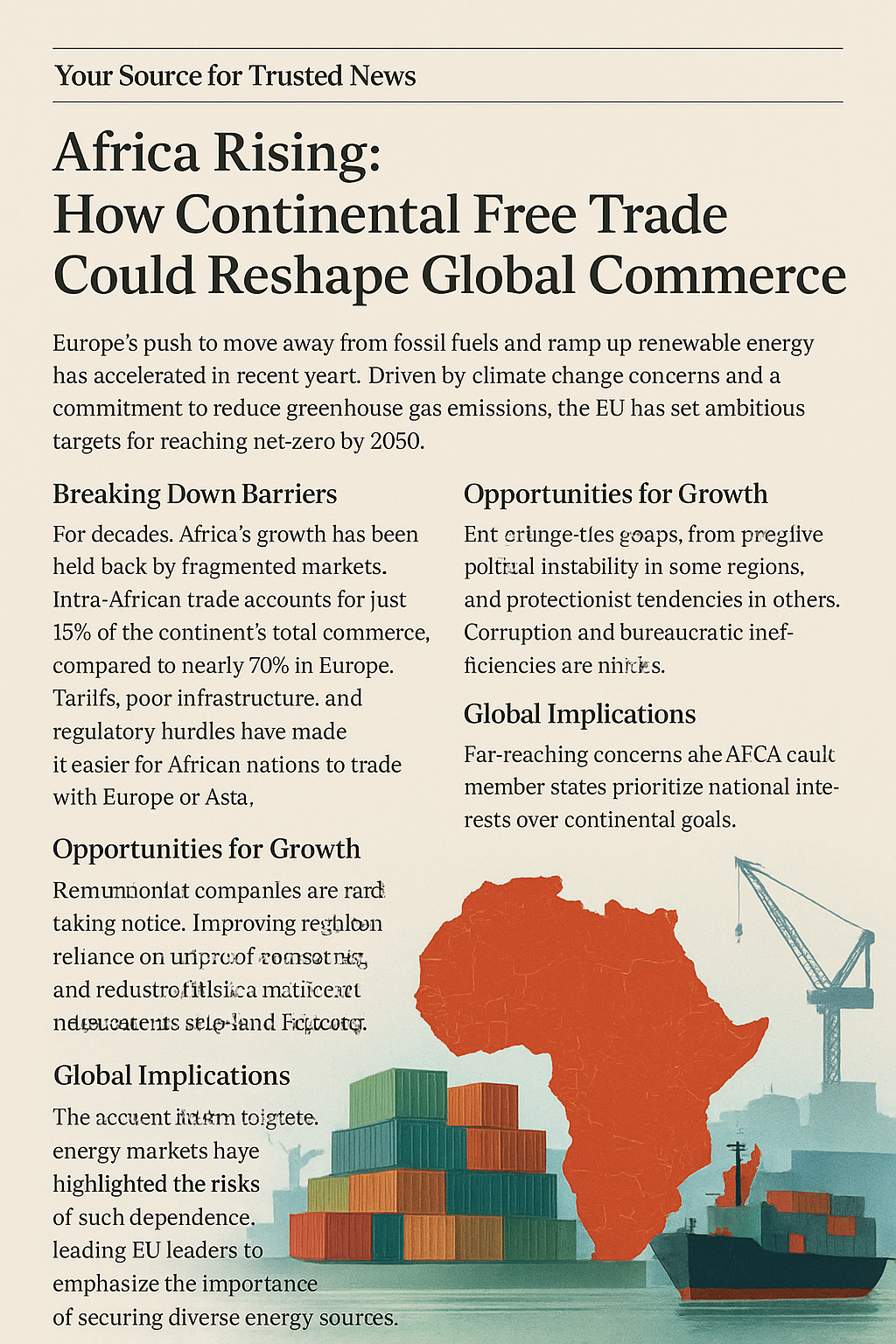
Africa is often described as the world’s last great economic frontier, and the African Continental Free Trade Area (AfCFTA) could be the key that unlocks its full potential. Launched in 2021, AfCFTA is the world’s largest free trade agreement by membership, bringing together 54 countries with a combined population of 1.4 billion and a GDP of over $3.4 trillion.
If fully implemented, it could reshape not just Africa’s economic destiny but global commerce itself.
Breaking Down Barriers
For decades, Africa’s growth has been held back by fragmented markets. Intra-African trade accounts for just 15% of the continent’s total commerce, compared to nearly 70% in Europe. Tariffs, poor infrastructure, and regulatory hurdles have made it easier for African nations to trade with Europe or Asia than with one another.
AfCFTA seeks to change that by eliminating tariffs on 90% of goods, harmonizing regulations, and investing in cross-border infrastructure. Early results are promising, with several countries reporting increased trade volumes in manufactured goods.
Opportunities for Growth
The potential is staggering. The World Bank estimates that AfCFTA could lift 30 million people out of extreme poverty and boost Africa’s income by $450 billion by 2035. Key growth areas include manufacturing, digital services, and renewable energy.
Multinational companies are taking notice. Automakers, tech firms, and agribusiness giants are investing in African hubs like Nairobi, Lagos, and Johannesburg, betting on the continent’s youthful population and expanding middle class.
Challenges on the Road Ahead
Despite its promise, AfCFTA faces hurdles. Infrastructure gaps, from poor road networks to unreliable power supply, remain major obstacles. Political instability in some regions threatens to derail progress, while protectionist tendencies in others could slow implementation.
Corruption and bureaucratic inefficiencies also present risks. “The agreement is only as strong as its enforcement,” noted one trade analyst. “If member states prioritize national interests over continental goals, momentum could stall.”
Global Implications
The success of AfCFTA has implications far beyond Africa. For Europe and the U.S., it could open new markets and investment opportunities. For China, already Africa’s largest trading partner, it presents both a challenge and an opportunity to deepen its influence.
Crucially, AfCFTA could help Africa move beyond its role as a raw materials exporter to become a hub for value-added manufacturing. That shift would not only transform African economies but also reshape global supply chains.
A Continent’s Future
For Africa’s young population — the fastest growing in the world — the agreement represents more than economics. It symbolizes a chance to redefine the continent’s role in global affairs.
As one African Union official put it: “This is not just about trade. It’s about Africa taking control of its own destiny.”
The world is watching. If Africa can overcome its challenges and harness the power of continental integration, AfCFTA could become one of the most consequential trade agreements of the 21st century. 700 701 702 703 704 705 706 707 708 709 710 711 712 713 714 715 716 717 718 719 720 721 722 723 724 725 726 727 728 729 730 731 732 733 734 735 736 737 738 739 740 741 742 743 744 745 746 747 748 749 750 751 752 753 754 755 756 757 758 759 760 761 762 763 764 765 766 767 768 769 770 771 772 773 774 775 776 777 778 779 780 781 782 783 784 785 786 787 788 789 790 791 792 793 794 795 796 797 798 799 800 801 802 803 804 805 806 807 808 809 810 811 812 813 814 815 816 817 818 819 820 821 822