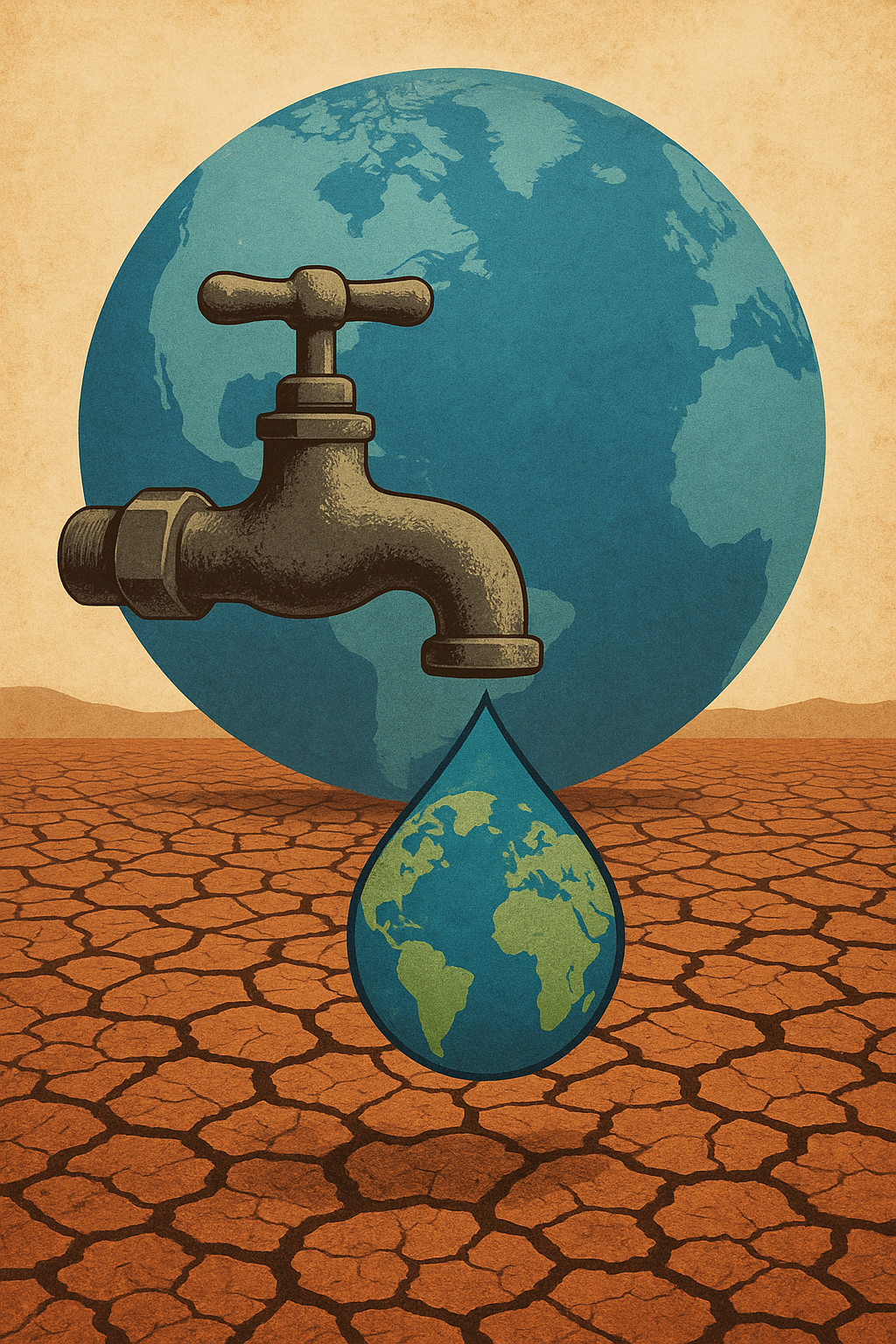
The Hidden Crisis
When people think of the world’s great challenges, they often picture rising seas, energy shortages, or geopolitical tensions. Yet behind these headlines lies a quieter but equally urgent crisis: water scarcity. More than two billion people today lack reliable access to safe drinking water. By 2050, the UN warns, half the global population could face severe water stress.
Unlike oil or gas, water has no substitute. It sustains agriculture, industry, energy, and, above all, human life. As demand surges and supply dwindles, the 21st century is shaping up to be defined not just by wars over territory or ideology, but by conflicts and cooperation over water.
Rising Demand, Shrinking Supply
The drivers of the crisis are both natural and man-made. Population growth is a key factor: the world is expected to add nearly two billion people by 2050, most of them in regions already water-stressed. Agriculture alone accounts for 70% of global freshwater use, much of it highly inefficient.
At the same time, climate change is making water less predictable. Droughts in the Horn of Africa, California, and southern Europe have devastated crops, while flooding in South Asia and East Africa has destroyed infrastructure and displaced millions. Melting glaciers in the Himalayas and Andes threaten long-term water supplies for billions.
Meanwhile, groundwater—the hidden reserve sustaining much of the world’s agriculture—is being depleted at alarming rates. Aquifers in India, China, and the Middle East are drying up, often faster than they can be replenished.
The Global Hotspots
-
The Middle East and North Africa: Already the most water-scarce region on Earth, MENA countries face mounting challenges as populations grow and aquifers shrink. Some nations, like Saudi Arabia, rely almost entirely on desalination, an energy-intensive and expensive process.
-
South Asia: Home to nearly two billion people, South Asia faces competing pressures from agriculture, urbanization, and climate change. Tensions between India and Pakistan over the Indus River basin illustrate the geopolitical stakes.
-
Sub-Saharan Africa: Rapid urbanization and climate shocks are straining already fragile water systems. In cities like Nairobi and Lagos, water shortages disproportionately affect the poor, fueling inequality.
-
North America and Europe: Even wealthy regions are not immune. California’s prolonged droughts, combined with record wildfires, highlight the vulnerabilities of advanced economies. Southern Europe faces similar pressures as rainfall patterns shift.
Technology as a Lifeline
Just as with energy, technology is playing a critical role in addressing scarcity. Innovations include:
-
Desalination 2.0: New methods using renewable energy and advanced membranes are making desalination cheaper and more sustainable. Israel now derives more than half its water from desalination plants.
-
Smart Irrigation: AI-powered systems optimize water use in agriculture, reducing waste and boosting yields. Drip irrigation pioneered in Israel is spreading globally.
-
Wastewater Recycling: Cities from Singapore to Los Angeles are reusing treated wastewater for drinking and industrial use, overcoming stigma with strong public campaigns.
-
Leak Detection and Infrastructure: Smart sensors and advanced materials are helping utilities reduce water losses from aging pipes, which can account for up to 40% of wasted supply in some cities.
The Politics of Water
Water is both a source of conflict and cooperation. Shared rivers and aquifers cross political boundaries, creating tension between upstream and downstream nations. The Nile, the Mekong, and the Jordan rivers have all been flashpoints for disputes.
Yet water can also foster collaboration. The Indus Waters Treaty, signed between India and Pakistan in 1960, has survived wars and political upheavals, offering a rare model of cooperation in a divided region. Similarly, initiatives in southern Africa have brought nations together to manage shared river basins.
As demand rises, experts warn that the risk of “water wars” is real—but so is the potential for water diplomacy to become a driver of peace.
The Human Toll
Beyond geopolitics, the crisis is deeply personal. In many parts of the world, women and children walk miles each day to fetch water. In rural sub-Saharan Africa, this burden keeps children out of school and women out of the workforce, perpetuating cycles of poverty.
Health is also at stake. Unsafe water is a leading cause of disease, with diarrheal illnesses killing nearly half a million people annually, most of them children under five. As climate change worsens, cholera outbreaks and other waterborne diseases are becoming more frequent.
A Call for Action
Experts argue that solving the water crisis requires a combination of local innovation, global cooperation, and political will. Pricing water to reflect its true value, investing in resilient infrastructure, and integrating water policy into climate planning are all critical steps.
But ultimately, water scarcity is not just a technical issue—it is a moral one. Who gets access, and who is left behind, reflects broader inequalities in our world. As one UN official put it: “Water is not just a resource. It is a human right.”
Looking Ahead
The coming decades will test humanity’s ability to manage this most precious resource. If nations choose competition over cooperation, the world could face conflicts more destabilizing than oil wars. But if water becomes a catalyst for innovation and peace, it could unite nations around a shared destiny.
The stakes could not be higher. As one African proverb reminds us: “When the well is dry, we know the worth of water.” In the 21st century, that lesson has never been more urgent.
1 2 3 4 5 6 7 8 9 10 11 12 13 14 15 16 17 18 19 20 21 22 23 24 25 26 27 28 29 30 31 32 33 34 35 36 37 38
700 701 702 703 704 705 706 707 708 709 710 711 712 713 714 715 716 717 718 719 720 721 722 723 724 725 726 727 728 729 730 731 732 733 734 735 736 737 738 739 740 741 742 743 744 745 746 747 748 749 750 751 752 753 754 755 756 757 758 759 760 761 762 763 764 765 766 767 768 769 770 771 772 773 774 775 776 777 778 779 780 781 782 783 784 785 786 787 788 789 790 791 792 793 794 795 796 797 798 799 800 801 802 803 804 805 806 807 808 809 810 811 812 813 814 815 816 817 818 819 820 821 822