Everything that has a beginning must have an end, and the universe is no exception.
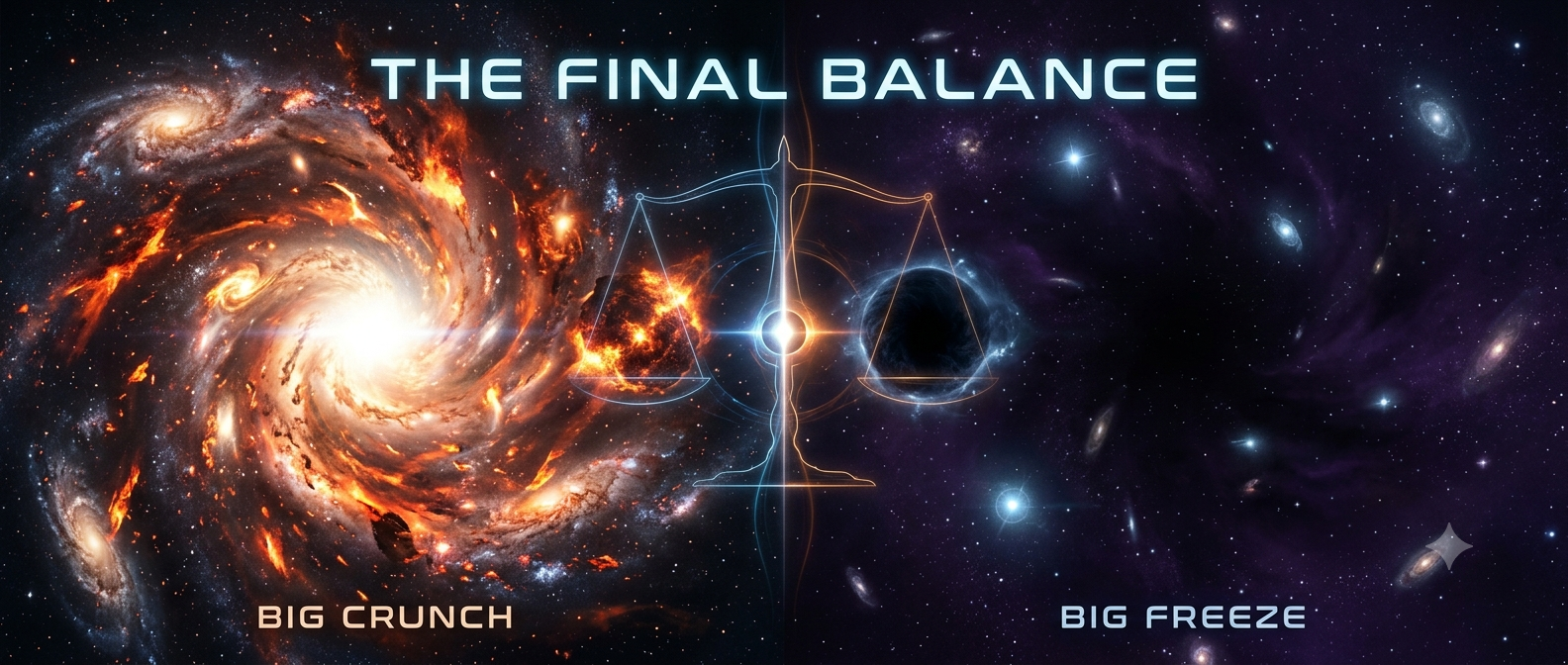
Ever since astronomer Edwin Hubble shocked the world in 1929 by proving that our universe is actively expanding, cosmologists have been obsessed with a singular, existential question: How does the story end? For decades, the debate was deadlocked between two titanic, opposing fates: the Big Freeze and the Big Crunch. Will reality stretch out forever until it snaps into a cold, dark void, or will gravity pull it all back into a fiery, cataclysmic collapse?
Thanks to advanced data from mapping satellites like WMAP and the Planck Observatory, modern astrophysics has finally weighed in on this cosmic tug-of-war. The results are definitive, mathematically elegant, and deeply haunting.
Scenario A: The Big Crunch (The Cosmic Snap-Back)
To understand the Big Crunch, imagine throwing a baseball straight up into the air. Initially, the force of your throw drives the ball upward, fighting against the Earth’s gravity. But as the ball ascends, gravity slows it down, brings it to a momentary halt, and drags it violently back down to the ground.
For much of the 20th century, scientists believed the universe functioned exactly like that baseball. The initial “throw” was the Big Bang. The “ground” was gravity.
If the collective gravitational pull of all the matter, gas, stars, and dark matter in the universe were strong enough, it would eventually slow the cosmic expansion to a complete standstill. From there, gravity would take total control, reversing the arrow of space and beginning an epic, accelerating contraction.
As the universe shrinks, galaxies would collide and merge. The Cosmic Microwave Background—the relic radiation left over from the Big Bang—would get compressed and spike in temperature. Millions of years before the final impact, the night sky would shine hotter and brighter than the surface of a star. Eventually, all matter, space, and time would smash back together into a single, infinitely dense, infinitely hot point: a singularity identical to the one we started with.
Some physicists poetically theorize that this could trigger a “Big Bounce,” sparking a brand-new Big Bang and a cyclical, never-ending universe.
Scenario B: The Big Freeze (The Eternal Winter)
The alternative scenario relies on the baseball being thrown so fast that it breaks Earth’s escape velocity entirely, sailing past the atmosphere and coasting into deep space forever. This is the Big Freeze, also known as the Heat Death of the universe.
In a Big Freeze scenario, the expansion of space never stops. Instead, galaxies drift farther and farther apart until they lose sight of one another entirely.
[Big Bang] ➔ [Galaxy Formation] ➔ [Accelerated Expansion] ➔ [Stars Die Out] ➔ 🛑 THE BIG FREEZE
As space dilates over trillions of years, the raw materials to form new stars—mostly hydrogen and helium dust clouds—are stretched too thin to collapse. The universe enters the Degenerate Era. The stars currently shining will burn through their fuel and die out, leaving behind cold remnants like white dwarfs, neutron stars, and black holes.
Eventually, even those remnants will decay. According to calculations by physicist Stephen Hawking, over unimaginable timescales (up to $10^{100}$ years), even black holes will completely evaporate via a slow leak of quantum radiation. The universe will reduce to a stagnant, uniform soup of isolated photons and leptons, frozen just a fraction of a degree above absolute zero. With no energy imbalances remaining, nothing new can ever happen. Time itself effectively loses all meaning.
The Verdict: Dark Energy Changes the Game
For decades, determining which end would occur was a simple matter of measuring the density of the universe. If the universe was dense enough, gravity won (Big Crunch). If it wasn’t, expansion won (Big Freeze).
But in 1998, astrophysics was thrown into chaos. By measuring distant, dying stars, astronomers discovered that the universe isn’t just expanding—it is accelerating. Something invisible is actively pushing space apart at an ever-increasing rate.
Scientists call this mysterious force Dark Energy, and it makes up a staggering 68.3% of the mass-energy budget of the cosmos.
Because Dark Energy acts as a sort of cosmic anti-gravity that grows stronger as space expands, it completely breaks the classic “baseball” analogy. It is as if the baseball is flying upward, and an invisible rocket booster suddenly attaches to it, blasting it into the dark at supersonic speeds.
Data gathered from the Cosmic Microwave Background has confirmed that the geometry of our universe is remarkably “flat.” This specific geometric shape, paired with the relentless, overpowering presence of Dark Energy, means that gravity has lost the tug-of-war.
The Big Crunch is highly unlikely. Barring a sudden, unpredictable shift where Dark Energy reverses its behavior in the distant future, the universe has already chosen its final chapter. We are bound for the Big Freeze—a slow, majestic, and completely silent fading of the light across an infinity of space.
700 701 702 703 704 705 706 707 708 709 710 711 712 713 714 715 716 717 718 719 720 721 722 723 724 725 726 727 728 729 730 731 732 733 734 735 736 737 738 739 740 741 742 743 744 745 746 747 748 749 750 751 752 753 754 755 756 757 758 759 760 761 762 763 764 765 766 767 768 769 770 771 772 773 774 775 776 777 778 779 780 781 782 783 784 785 786 787 788 789 790 791 792 793 794 795 796 797 798 799 800 801 802 803 804 805 806 807 808 809 810 811 812 813 814 815 816 817 818 819 820 821 822