In the vast, luminous tapestry of the cosmos, some entities choose to remain entirely in the shadows. A joint international observational campaign spearheaded by the Hubble Space Telescope has officially identified an ultra-diffuse “ghost galaxy” that challenges our fundamental understanding of galactic architecture.
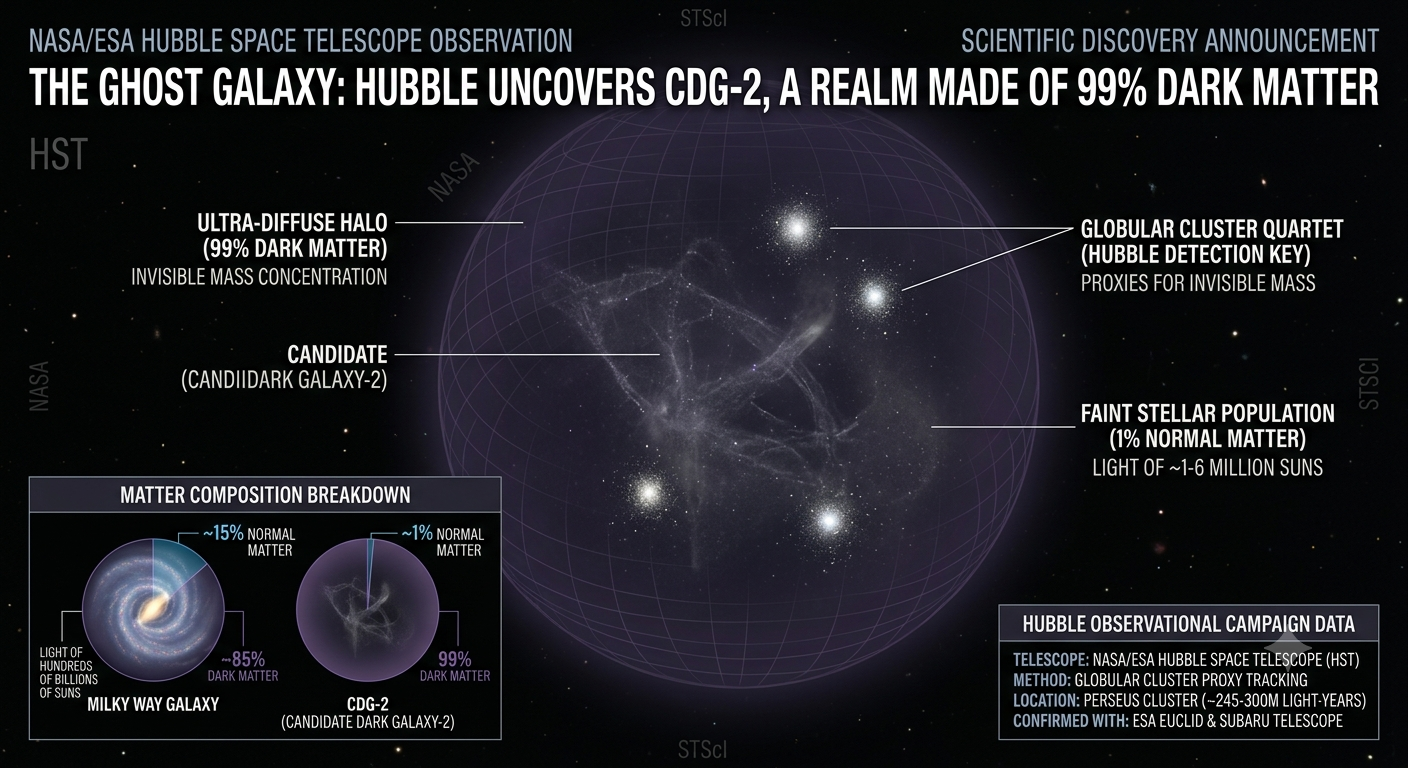
Designated as Candidate Dark Galaxy-2 (CDG-2), this newly confirmed cosmic anomaly appears to be almost completely devoid of normal matter. While a standard galaxy like our Milky Way blazes with the light of hundreds of billions of stars, CDG-2 emits a ghostly, ultra-faint glow equivalent to only about 1 to 6 million suns. According to astrophysics teams, a staggering 99% of the galaxy’s total mass is comprised entirely of invisible dark matter.
Cosmic Comparison: How CDG-2 Stacks Up
To understand just how radical CDG-2 is, it helps to compare its properties directly to our own galactic home:
| Galactic Feature | The Milky Way | Candidate Dark Galaxy-2 (CDG-2) |
| Primary Composition | Balanced (Normal matter forms visible structures) | ~99% Dark Matter (Nearly invisible) |
| Total Stellar Luminosity | Hundreds of billions of Suns | ~1 to 6 million Suns |
| Globular Star Clusters | 150+ clusters | Only 4 clusters |
| Cosmic Neighborhood | The Local Group | Perseus Cluster (~245–300M light-years away) |
Cosmic Detective Work: Tracking the Invisible
Because dark matter does not emit, absorb, or reflect light, finding a galaxy ruled entirely by it requires unprecedented astronomical detective work. An international team led by David Li at the University of Toronto managed to locate CDG-2 not by looking for stars, but by hunting for their cosmic anchors: globular clusters.
Globular clusters are tightly bound, ancient spheres of stars that are highly resistant to being torn apart by gravitational forces. Using advanced statistical modeling to scan the densely packed Perseus galaxy cluster, researchers noticed a bizarre, isolated grouping of just four globular clusters.
To confirm if something was hiding behind them, astronomers deployed a powerhouse trio of hardware:
-
The Hubble Space Telescope provided high-resolution imaging to pin down the exact coordinates of the cluster quartet.
-
ESA’s Euclid Space Telescope delivered wide-field sensitivity to detect the incredibly faint, diffuse halo of light surrounding them.
-
The ground-based Subaru Telescope in Hawaii verified the underlying galactic structure.
“This is the first galaxy detected solely through its globular cluster population,” Li noted in a scientific statement, marking a massive milestone for observational astronomy.
The Mystery of the Missing Matter
Why is CDG-2 so drastically starved of ordinary matter? Galaxies typically require vast reservoirs of hydrogen gas to seed and birth new generations of stars. However, CDG-2 resides inside the Perseus Cluster—a chaotic, high-density cosmic environment.
Astronomers theorize that early in its life cycle, CDG-2 fell victim to gravitational stripping. As it interacted with larger, more massive neighboring galaxies, its loose, unbound hydrogen gas was violently pulled away. Without the raw material needed to manufacture stars, its stellar production ground to a permanent halt. Only its heavily packed globular clusters were structurally dense enough to survive the gravitational theft, leaving behind a pristine, invisible skeleton of dark matter.
Why CDG-2 Matters to Science
The discovery of CDG-2 offers physicists a flawless natural laboratory. Because the galaxy lacks the complex, messy interference of massive star-forming regions and gas clouds, scientists can study the distribution of dark matter in its purest, most isolated state.
As upcoming deep-space surveys map wider swaths of the sky, teams hope to discover whether CDG-2 is a rare cosmic anomaly or merely the first of a hidden, silent majority of dark galaxies lurking in the shadows of the universe.
700 701 702 703 704 705 706 707 708 709 710 711 712 713 714 715 716 717 718 719 720 721 722 723 724 725 726 727 728 729 730 731 732 733 734 735 736 737 738 739 740 741 742 743 744 745 746 747 748 749 750 751 752 753 754 755 756 757 758 759 760 761 762 763 764 765 766 767 768 769 770 771 772 773 774 775 776 777 778 779 780 781 782 783 784 785 786 787 788 789 790 791 792 793 794 795 796 797 798 799 800 801 802 803 804 805 806 807 808 809 810 811 812 813 814 815 816 817 818 819 820 821 822