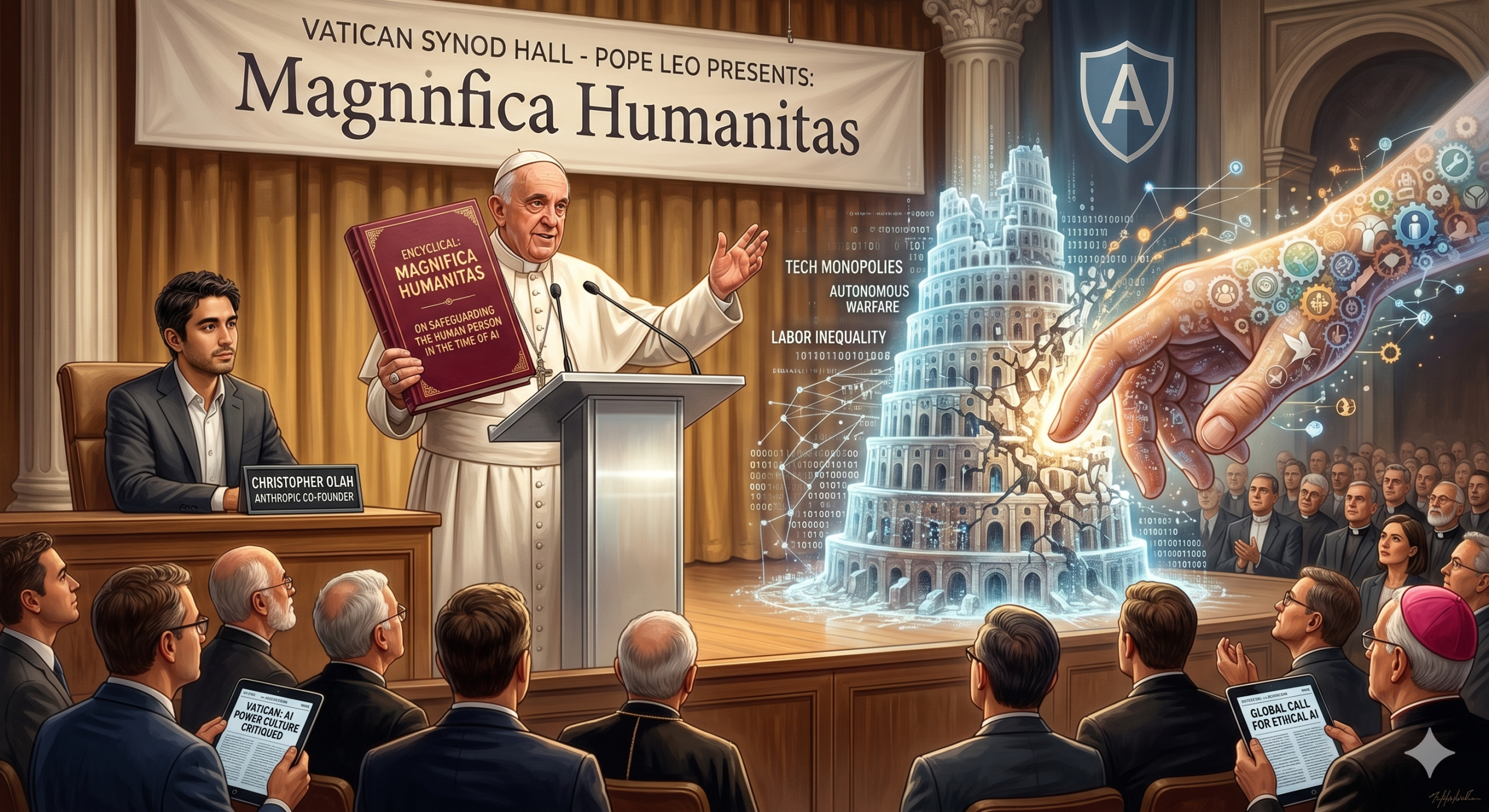
VATICAN CITY — In what is being heralded as a historic and profound disruption to the global technology discourse, Pope Leo XIV has issued the first major written teaching of his papacy: a sweeping, 42,300-word encyclical titled “Magnifica Humanitas” (Magnificent Humanity: On Safeguarding the Human Person in the Time of Artificial Intelligence).
Breaking sharply from centuries of Vatican tradition regarding the formal presentation of papal texts, Pope Leo personally presented the document at the Synod Hall. In a highly unusual move signaling a desire for direct dialogue with Silicon Valley, he was flanked on stage by an unexpected guest speaker: Christopher Olah, a co-founder of the prominent frontier AI safety lab Anthropic.
The encyclical does not issue a blanket condemnation of technological progress. Instead, it takes aim squarely at the “culture of power” dominating the modern tech sector, laying out strict moral guardrails to protect human dignity, justice, and labor from an unchecked algorithmic race.
Dismantling the Tower of Silicon Monopolies
Framing his theological argument around the biblical narrative of the Tower of Babel, Pope Leo warns that an unrestrained corporate obsession with AI optimization risks fostering a harmful homogenization. He cautions that when efficiency becomes the ultimate measure of society, humanity is tempted to treat itself as a “project to be optimized” rather than a community built on relationships.
The Pope directs his sharpest rhetoric at the small, highly influential commercial tech monopolies currently steering the global economy. The text explicitly warns against leaving the development of transformative AI models solely in the hands of these entities, noting that unrestricted algorithmic capitalism naturally amplifies the power of those who already possess vast economic resources and data. By doing so, he notes, commercial giants gain the dangerous ability to arbitrarily steer economic dynamics, manipulate consumer patterns, and quietly undermine democratic processes.
A Provocative Call to “Disarm AI”
To counter this structural drift, Magnifica Humanitas introduces a striking geopolitical demand: artificial intelligence must be intentionally “disarmed”.
“The word is strong, I know, but deliberately chosen,” Pope Leo stated during the presentation. He calls on international governing bodies to actively intervene, slowing down the breakneck pace of corporate deployment to ensure communities can participate in the architectural conversation. Disarming AI, according to the text, requires freeing the technology from toxic military and economic hyper-competition, stripping away monopolistic control, and exposing foundational systems to rigorous, public oversight.
Killer Robots and Global Labor Fractures
The document takes an unyielding stance on the proliferation of AI in modern warfare, echoing and expanding upon the warnings of his predecessor, Pope Francis. Pope Leo strongly denounces the deployment of autonomous weapon systems, warning that letting machines make lethal judgments creates a dangerous psychological distance that makes war seem more “feasible” and less subject to human accountability. The encyclical demands “the most rigorous ethical constraints” on military AI, declaring that life-and-death decisions can never be delegated to automated processes.
Turning to the global economy, the Pope aligns his message with the worker-centric lineage of Pope Leo XIII’s landmark 1891 encyclical Rerum Novarum. He warns that substituting human labor with rapid, automated systems threatens to push vulnerable populations into “forced inactivity,” fundamentally stripping individuals of the dignity found in honest work and exacerbating global economic inequality.
The Limits of the Machine
Ultimately, Magnifica Humanitas serves as a philosophical reminder of the boundaries of computation. While acknowledging that AI can convincingly simulate language, behavior, and even empathy, Pope Leo reminds the world’s 1.4 billion Catholics—and the broader international community—that data processing must never be confused with human conscience.
“No computational system, however sophisticated,” the text reads, “can create a heart that gives itself, or a conscience that discerns good from evil”. With states scheduled to gather at the United Nations later this year to debate the military implementation of artificial intelligence, the Vatican’s massive theological treatise arrives as an urgent, highly authoritative demand to put human accountability back at the center of the digital age.
1 2 3 4 5 6 7 8 9 10 11 12 13 14 15 16 17 18 19 20 21 22 23 24 25 26 27 28 29 30 31 32 33 34 35 36 37 38
700 701 702 703 704 705 706 707 708 709 710 711 712 713 714 715 716 717 718 719 720 721 722 723 724 725 726 727 728 729 730 731 732 733 734 735 736 737 738 739 740 741 742 743 744 745 746 747 748 749 750 751 752 753 754 755 756 757 758 759 760 761 762 763 764 765 766 767 768 769 770 771 772 773 774 775 776 777 778 779 780 781 782 783 784 785 786 787 788 789 790 791 792 793 794 795 796 797 798 799 800 801 802 803 804 805 806 807 808 809 810 811 812 813 814 815 816 817 818 819 820 821 822