The 2026 AI Index Report, released by Stanford’s Institute for Human-Centered AI (HAI) on April 13, 2026, marks a pivotal shift in the artificial intelligence landscape. The 500-page document reveals that while AI capabilities are accelerating at an unprecedented rate, the physical and environmental costs associated with this growth have reached a critical tipping point.
1. The Environmental Cost of Intelligence
The report underscores that AI’s progress now rests on a massive physical foundation of data centers, power, and water, leading to significant environmental strain.
-
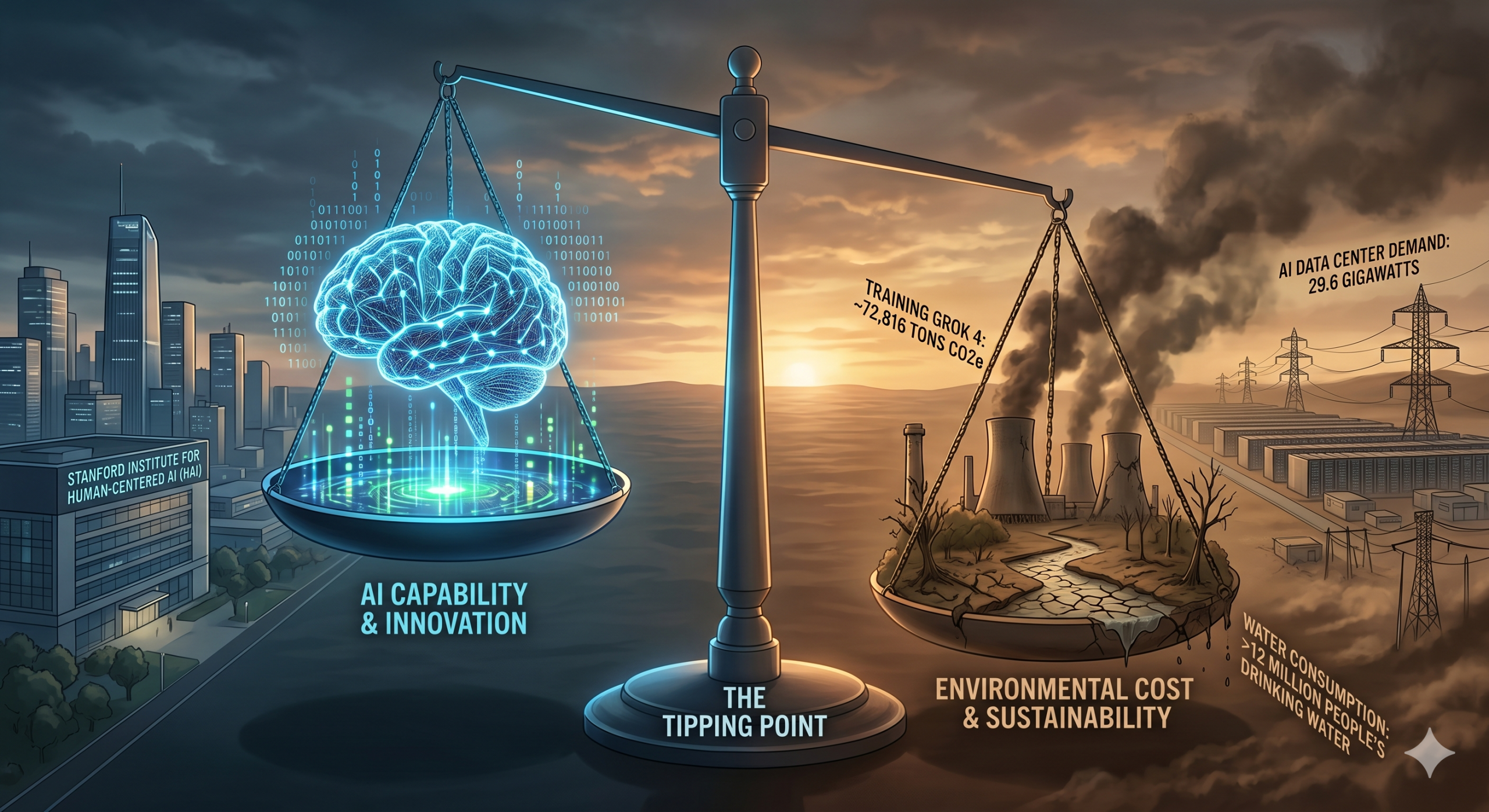
Carbon Emissions: Training a single state-of-the-art model like xAI’s Grok 4 emitted an estimated 72,816 tons of $CO_2$ equivalent. This is roughly equal to the annual exhaust of 17,000 passenger vehicles.
-
Water Consumption: The report highlights a “water scarcity” issue, noting that annual inference for a model like GPT-4o may consume more cooling water than is needed to meet the drinking requirements of 12 million people.
-
Energy Demand: AI data center power capacity has surged to 29.6 gigawatts, a level comparable to the peak electricity demand of New York State.
2. Soaring Capabilities & Benchmark Saturation
Technical performance is moving so fast that traditional benchmarks are becoming obsolete within months.
-
Humanity’s Last Exam: Frontier models gained a staggering 30 percentage points on this expert-level benchmark in just one year.
-
Mathematical Reasoning: AI has moved from a silver medal in 2024 to a gold medal at the International Mathematical Olympiad (IMO) in 2025, solving complex problems end-to-end in natural language.
-
Video Generation: New models, such as Veo 3, are demonstrating “zero-shot” reasoning, simulating physical properties like buoyancy and solving mazes without specific training on those tasks.
3. Workforce Disruption and Economic Shifts
The “intelligence boom” is reshaping the labor market and capital allocation.
-
The “Junior” Squeeze: There is growing evidence of a “Junior Displacement Crisis,” with employment for software developers in the 22–25 age group dropping by 20% last year as autonomous agents began handling entry-level tasks.
-
Data Center Boom: U.S. investment in AI data centers reached record highs, with $36.9 billion in construction starts recorded in the first two months of 2026 alone.
-
Corporate Adoption: Generative AI has reached a 53% global penetration rate within three years of launch, spreading faster than either the PC or the internet.
4. Public Sentiment and Governance Gaps
Despite the utility of AI, societal anxiety is deepening.
-
AI Phobia: While 59% of people find AI products helpful, 52% report feeling anxious about the technology.
-
Safety Incidents: Reported AI-related accidents rose by 55% last year, totaling 362 incidents.
-
Responsibility Gap: The report warns of a widening gap between AI’s technical possibilities and society’s readiness to manage, regulate, and safely absorb them.
“We are moving from the ‘era of AI evangelism’ into a phase where AI is judged on real performance inside real systems, with real constraints and real costs attached.”
700 701 702 703 704 705 706 707 708 709 710 711 712 713 714 715 716 717 718 719 720 721 722 723 724 725 726 727 728 729 730 731 732 733 734 735 736 737 738 739 740 741 742 743 744 745 746 747 748 749 750 751 752 753 754 755 756 757 758 759 760 761 762 763 764 765 766 767 768 769 770 771 772 773 774 775 776 777 778 779 780 781 782 783 784 785 786 787 788 789 790 791 792 793 794 795 796 797 798 799 800 801 802 803 804 805 806 807 808 809 810 811 812 813 814 815 816 817 818 819 820 821 822