The “open-source vs. proprietary” gap has effectively vanished this month. With the late April 2026 releases from Alibaba and DeepSeek, developers now have access to open-weights models that not only rival but occasionally exceed the performance of “Legacy” frontier models like GPT-4o, specifically in the domains of high-end coding and symbolic reasoning.
1. Alibaba’s Qwen 3.6-35B: The Efficiency King
Released as an open-weights model on April 13, 2026, Qwen 3.6-35B-A3B has become the gold standard for “efficient intelligence.”
-
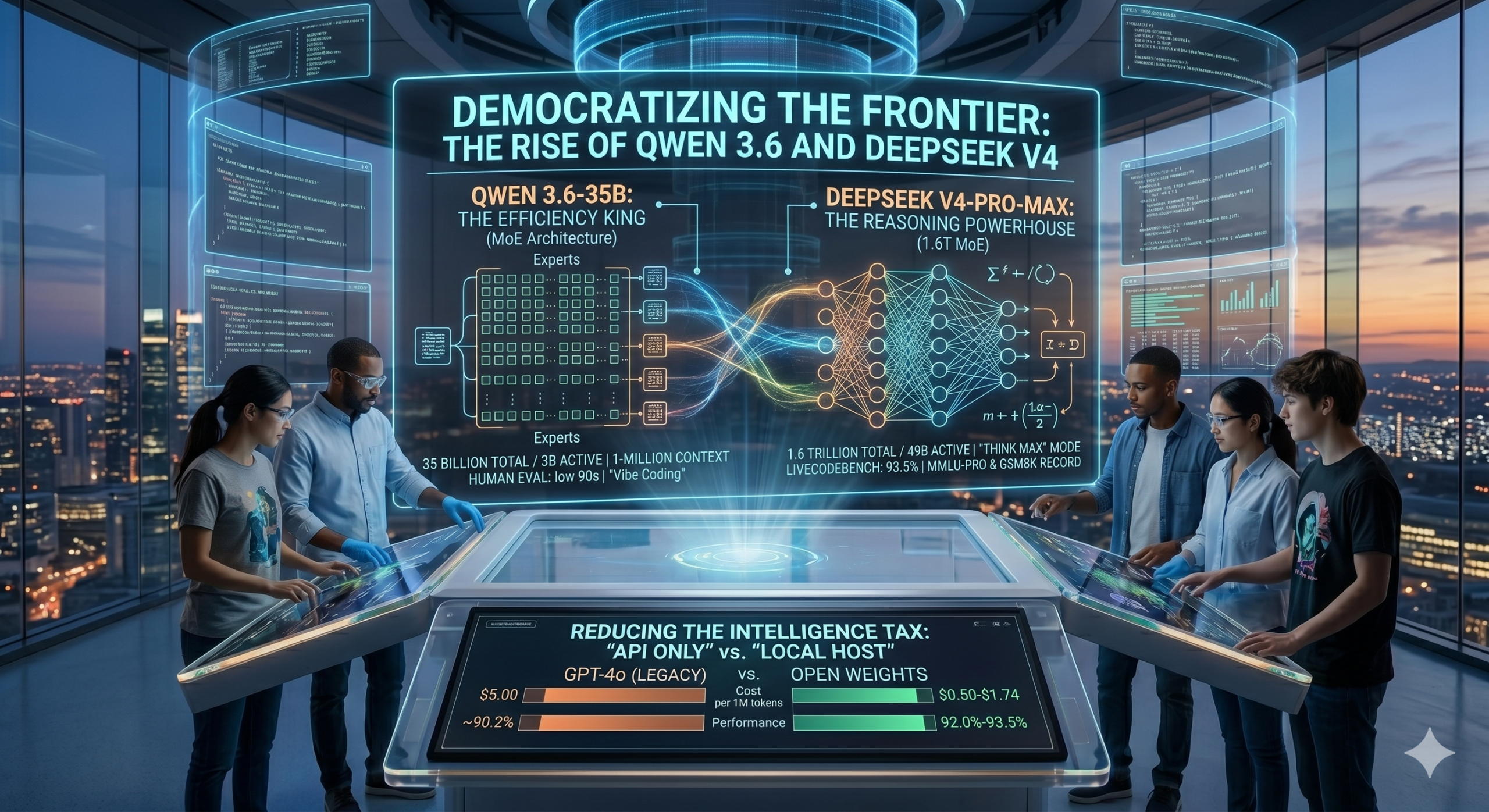
The MoE Breakthrough: It utilizes a sparse Mixture-of-Experts (MoE) architecture with 35 billion total parameters, but only 3 billion active parameters per token. This allows it to run with the speed of a small model while maintaining the reasoning depth of a giant.
-
1-Million-Token Context: It natively supports a 1M context window, matching the industry’s longest windows. This enables developers to feed entire codebases into the model for “repository-level” debugging without needing complex RAG (Retrieval-Augmented Generation) setups.
-
Coding Performance: On the HumanEval benchmark, Qwen 3.6-35B scored in the low 90s, placing it in direct competition with GPT-4o and Claude 3.5 Sonnet. It is particularly noted for “vibe coding”—the ability to interpret vague, intent-based instructions into functional front-end code.
2. DeepSeek V4-Pro-Max: The Reasoning Powerhouse
Released on April 22, 2026, DeepSeek V4-Pro-Max is the largest and most ambitious open-weights model to date, designed to handle the most complex symbolic logic tasks.
-
Massive Scale: The Pro-Max version is a 1.6-trillion-parameter MoE model (with 49 billion active parameters). It is built on a new Hybrid Attention Architecture that makes its 1M context window remarkably memory-efficient, using only 10% of the KV cache required by previous generations.
-
“Think Max” Mode: DeepSeek introduced three reasoning effort tiers. In “Think Max” mode, the model performs internal self-verification loops before answering. In this state, it achieved a staggering 93.5% on LiveCodeBench, outperforming the standard GPT-4o in competitive programming and math.
-
Logic & Math: It has set a new open-source record on GSM8K (92.6%) and MMLU-Pro (87.5%), proving that open models can now handle graduate-level symbolic reasoning and complex multi-step theorem proving.
3. The Impact: Democratizing the “Frontier”
The primary headline for developers in April 2026 is the drastic reduction in the “Intelligence Tax.”
The “Legacy” Comparison
| Feature | GPT-4o (Legacy) | Qwen 3.6-35B / DeepSeek V4 |
| Availability | API Only (Proprietary) | Open Weights (Local Hosting) |
| Context Window | 128K Tokens | 1 Million Tokens |
| Cost (per 1M tokens) | ~$5.00 | $0.50 – $1.74 |
| Coding (HumanEval) | ~90.2% | 92.0% – 93.5% |
Local Autonomy
For the first time, a developer can host a model on a personal GPU cluster (or high-end Mac Studio) that possesses the logic-handling capabilities that previously required a multi-billion-dollar server farm. This is enabling:
-
Private Dev-Agents: Running fully autonomous coding agents (like OpenCode) entirely offline for sensitive enterprise projects.
-
Massive Agentic Workflows: Because the cost is 10x lower than proprietary APIs, developers are running thousands of parallel “thinking” steps to solve massive architecture problems that were previously too expensive to automate.
This shift marks the “end of the beginning” for AI development; the bottleneck is no longer access to a powerful model, but rather the creativity of the developer using it.
700 701 702 703 704 705 706 707 708 709 710 711 712 713 714 715 716 717 718 719 720 721 722 723 724 725 726 727 728 729 730 731 732 733 734 735 736 737 738 739 740 741 742 743 744 745 746 747 748 749 750 751 752 753 754 755 756 757 758 759 760 761 762 763 764 765 766 767 768 769 770 771 772 773 774 775 776 777 778 779 780 781 782 783 784 785 786 787 788 789 790 791 792 793 794 795 796 797 798 799 800 801 802 803 804 805 806 807 808 809 810 811 812 813 814 815 816 817 818 819 820 821 822