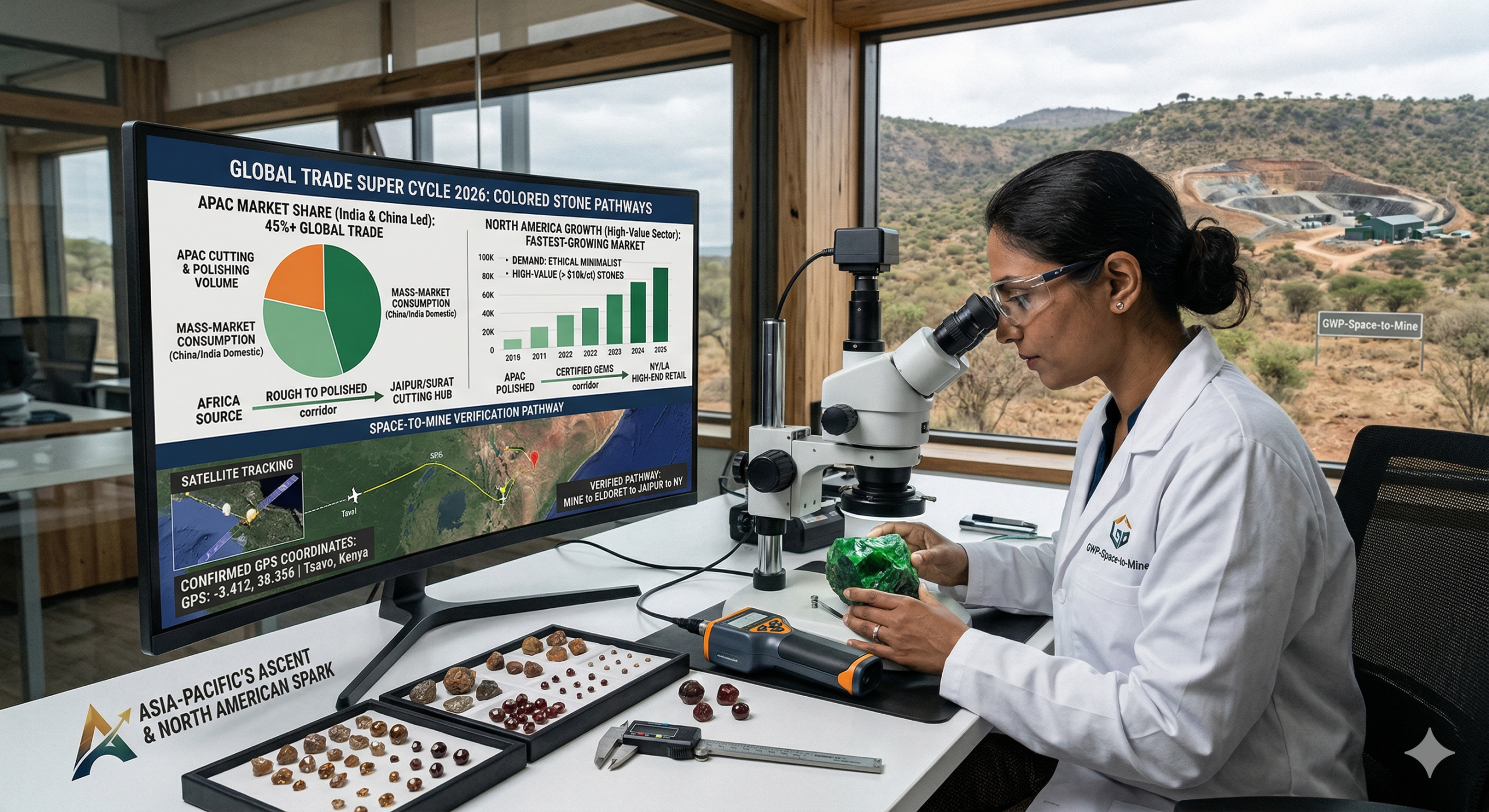
March 22, 2026 – The landscape of the multi-billion dollar colored gemstone industry has dramatically realigned, driven by unprecedented economic shifts in both the East and the West. While Kenya and other key African sourcing regions continue to provide the raw materials, the global trade is now a tale of two dominant poles: Asia-Pacific’s unrivaled control over volume and North America’s explosive hunger for high-value quality.
The newest industry-wide data, released this week, confirms a “seismic shift” in market power. The Asia-Pacific region, spearheaded by the economic powerhouses of India and China, currently controls over 45% of the total global trade in colored stones. Simultaneously, North America has firmly established itself as the fastest-growing market for high-value colored stones, signaling a powerful new era of ethical and aesthetic luxury consumption.
The Asia-Pacific Super-Traders: India and China Take the Reins
The Asia-Pacific’s 45%+ global trade share is more than a simple metric; it is a testament to the region’s dual strength in both cutting expertise and massive domestic demand. For centuries, India has been the global hub for cutting and polishing, particularly in Jaipur and Surat. But in 2026, Indian companies are moving beyond simple processing.
They are leveraging advanced logistics, Space-to-Mine Tracking, and direct sourcing partnerships with African cooperatives to vertically integrate. The resulting streamlined supply chain ensures that almost half of all stones, by weight and volume, flow through APAC ports and exchanges.
China, meanwhile, has emerged as the single largest consumer market for mass-market colored stones. Fueled by a growing middle class and the mainstream acceptance of vibrant alternatives like ‘Fanta’ orange Spessartite and vivid green Tsavorite, Chinese demand has provided the volume that sustains large-scale, Waterless Mining operations globally.
“India is the engine, and China is the fuel,” says Dr. Aris Thorne, a global mineral economist. “Their combined infrastructure and consumption create a gravitational pull that is hard for other regions to match in sheer volume.”
The North American Spark: High-Value Ethics Over Volume
While Asia-Pacific dominates the middle-to-high volume sectors, North America is rewriting the rules for high-value, bespoke luxury. It is the fastest-growing market for colored gems valued at $10,000+ per carat.
This trend is not about quantity; it is about quality and provenance. The primary drivers are affluent Gen X and millennial consumers who are deserting traditional white diamonds for stones that offer two things: understated elegance and “verifiable pathways.”
“The North American consumer of 2026 is an informed, ethical minimalist,” notes Elena Rossi, a luxury trend analyst. “They want the unique color of a ‘Coffee Diamond’ or a natural ‘Champagne Morganite,’ but they also demand data. They want to see the satellite coordinates of the mine and the blockchain entry proving the stone hasn’t funded environmental destruction.”
This has resulted in staggering growth in North American high-end sales:
| Metric (2025-2026) | North American Growth (High-Value Sector) | Global Average (High-Value Sector) |
| Sales Revenue (Stones >$10k/ct) | 24.1% | 8.8% |
| Demand for Low-H2O Certified Stones | 31.5% | 12.2% |
| Price-per-Carat for Untreated Tsavorite | 19.8% | 6.5% |
High-end jewelers in New York, Los Angeles, and Toronto are increasingly branding entire lines around their specific ethical certifications, a strategy that is paying off significantly with a younger demographic prioritizing conscience in their luxury purchases.
The Africa-India-North America Corridor
For Nakuru and the wider Kenyan mining community, this two-pole dynamic is reshuffling the trading board. Traditionally, Kenyan rough material might move through brokers in Europe or Thailand before reaching the West. Today, the most direct and profitable pathway is a high-tech “Africa-India-North America Corridor.”
Stones are extracted via certified, sustainable Kenyan operations. These stones (along with their digital birth certificate and satellite tracking data) move directly to sophisticated Indian cutting facilities that specialize in high-precision, low-waste processing. The resulting polished gems are then exported, with their “Space-to-Mine Tracking” data verified, directly into the booming high-value retail market of North America.
“The 2026 supercycle is about intelligence, not just materials,” concludes Jonathan Weiss, a broker in Nakuru. “We are seeing that the most successful trade routes are not just physical; they are digital pathways of trust that link African origin directly to North American ethical luxury.”
700 701 702 703 704 705 706 707 708 709 710 711 712 713 714 715 716 717 718 719 720 721 722 723 724 725 726 727 728 729 730 731 732 733 734 735 736 737 738 739 740 741 742 743 744 745 746 747 748 749 750 751 752 753 754 755 756 757 758 759 760 761 762 763 764 765 766 767 768 769 770 771 772 773 774 775 776 777 778 779 780 781 782 783 784 785 786 787 788 789 790 791 792 793 794 795 796 797 798 799 800 801 802 803 804 805 806 807 808 809 810 811 812 813 814 815 816 817 818 819 820 821 822

