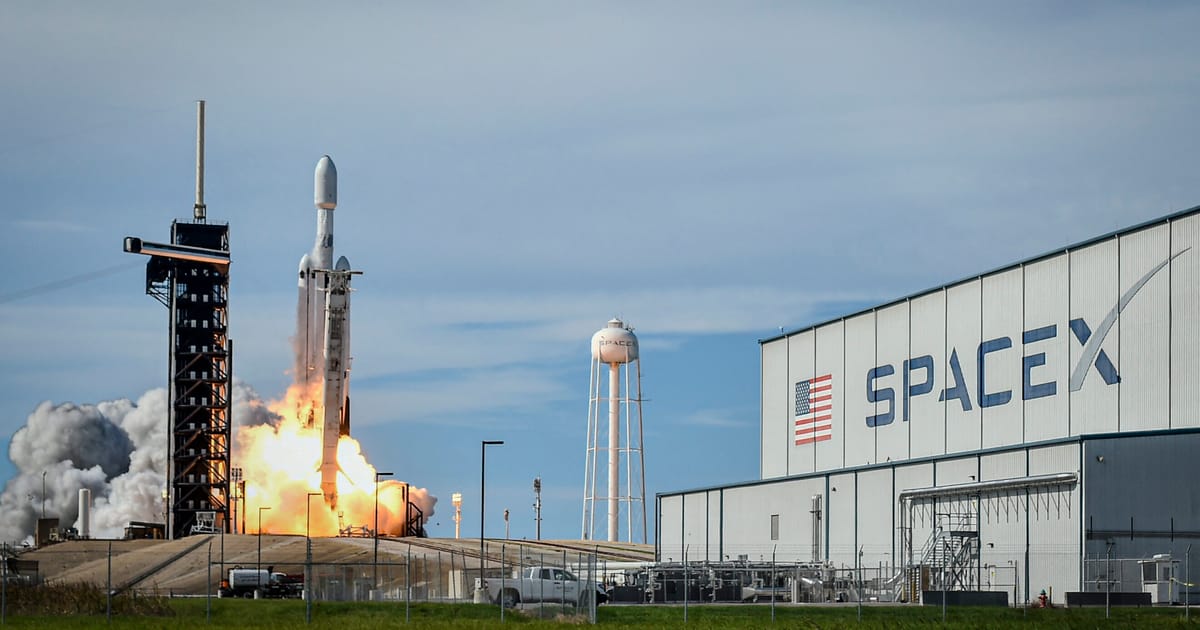
CAPE CANAVERAL, FL — March 10, 2026 — SpaceX has solidified its dominance in the low-Earth orbit (LEO) market, successfully completing its 30th orbital mission of 2026 in just over ten weeks. The mission, which launched at 12:19 a.m. EDT from Cape Canaveral Space Force Station, successfully deployed the EchoStar XXV satellite. While this specific payload was a commercial television satellite, the rapid cadence of 2026 has pushed the company’s total active Starlink constellation toward the historic 10,000-satellite mark.
This milestone represents a staggering feat of aerospace engineering and logistics, as SpaceX now manages nearly 50% of all active satellites currently orbiting Earth.
A Relentless Launch Cadence
SpaceX’s 30th mission of the year underscores a launch frequency that has become routine yet remains unprecedented. To reach 30 launches by early March, the company has averaged a liftoff every 2.4 days.
-
The Mission: A veteran Falcon 9 booster (B1085) made its 14th flight, successfully delivering the 15,000-pound EchoStar XXV satellite to a Geostationary Transfer Orbit (GTO).
-
Starlink Saturation: Of the 30 missions conducted so far in 2026, 24 have been dedicated Starlink launches.
-
The 10,000 Milestone: As of mid-March, SpaceX has launched over 11,500 Starlink satellites in total. With intentional de-orbiting of older models, the number of operational satellites in the constellation is now hovering just under 10,000.
Network Upgrades: Enter the Terabit Era
The sheer number of satellites is only half the story. SpaceX is currently transitioning its constellation to Starlink Version 3 (V3) and V2-Mini hardware.
According to a recent network update, these new-generation satellites are designed to provide:
-
1 Terabit per second (Tbps) of downlink capacity per satellite.
-
Direct-to-Cell capabilities, allowing standard smartphones to connect to the satellite network without specialized hardware.
-
Reduced Latency: Median peak-hour latency in the U.S. has dropped to 25.7 milliseconds, rivaling many terrestrial fiber-optic connections.
The “Agentic” Infrastructure
The expansion to 10,000 satellites is critical for the emerging “Agentic AI” economy. Autonomous systems—from self-driving trucks to industrial drones—require persistent, high-bandwidth connectivity to function outside of major urban centers. By blanketing the globe with high-speed, low-latency internet, SpaceX is providing the “nervous system” for these AI agents to operate in real-time across the most remote parts of the planet.
“We are moving past the era of ‘global internet’ and into the era of ‘global ubiquitous compute,'” said a senior SpaceX engineer during the post-launch broadcast. “A constellation of 10,000 satellites means that there is virtually no dead zone on Earth for an AI agent to lose its connection to the hive.”
SpaceX 2026: By The Numbers
| Metric | Value |
| Total Launches in 2026 (to date) | 30 |
| Active Starlink Satellites | ~9,949 |
| Total Subscribers | > 5 Million |
| Average Launch Interval | 58 Hours |
| Booster Reusability Record | 25+ Flights (B1062) |
700 701 702 703 704 705 706 707 708 709 710 711 712 713 714 715 716 717 718 719 720 721 722 723 724 725 726 727 728 729 730 731 732 733 734 735 736 737 738 739 740 741 742 743 744 745 746 747 748 749 750 751 752 753 754 755 756 757 758 759 760 761 762 763 764 765 766 767 768 769 770 771 772 773 774 775 776 777 778 779 780 781 782 783 784 785 786 787 788 789 790 791 792 793 794 795 796 797 798 799 800 801 802 803 804 805 806 807 808 809 810 811 812 813 814 815 816 817 818 819 820 821 822