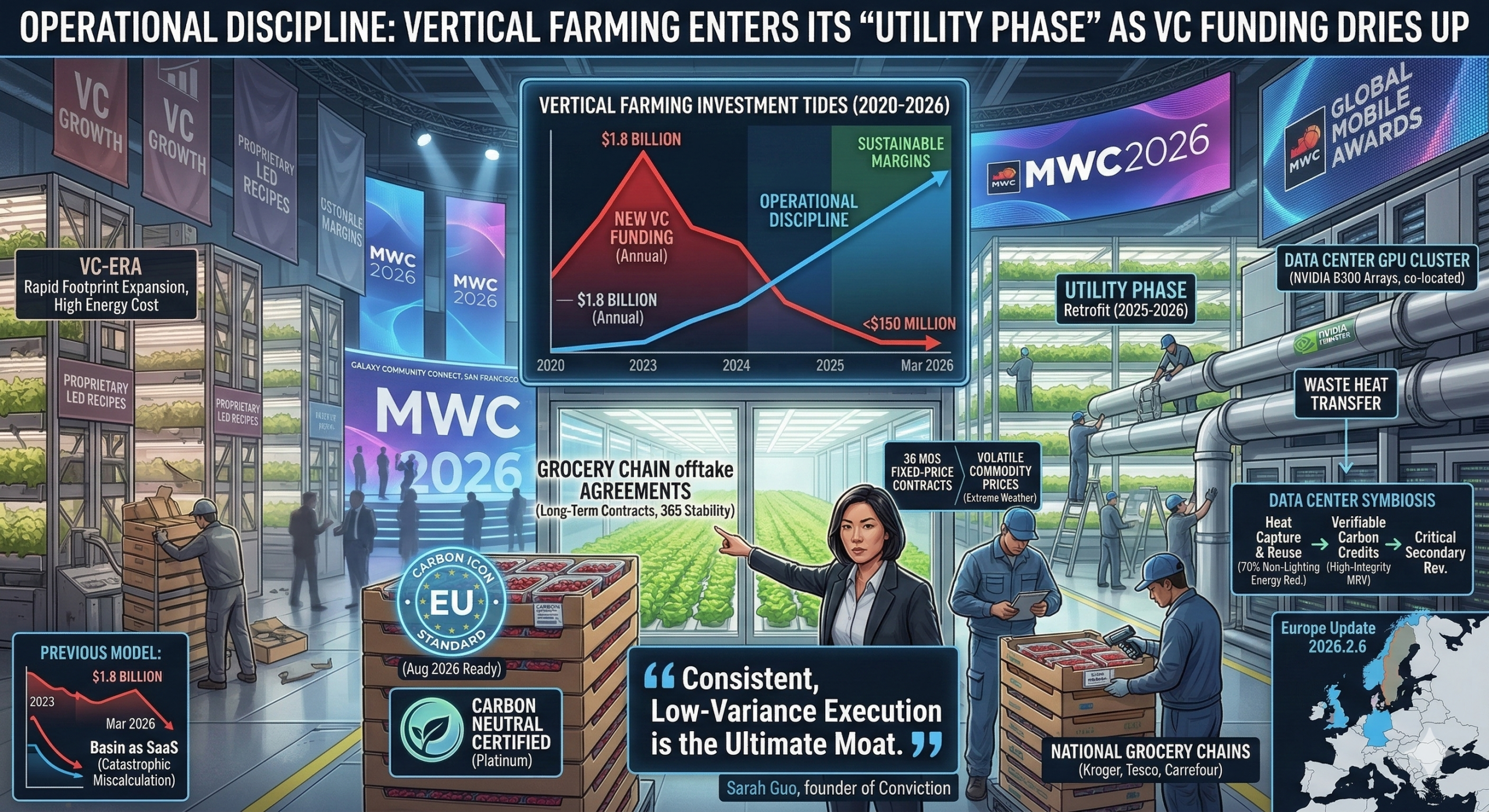
SAN FRANCISCO / NAIROBI — March 9, 2026 — The “Venture Capital era” of indoor farming is officially over. After a wave of spectacular bankruptcies in 2025 (including Bowery and Plenty) and a complete recalibration of venture funding, the sector is entering what analysts are calling its “Utility Phase.”
Survival is now defined not by rapid footprint expansion or proprietary LED recipes, but by relentless operational discipline. The surviving operators in 2026 are aggressively focused on two critical pillars: deep energy optimization—specifically using waste heat from adjacent data centers—and securing long-term, high-volume supply agreements with national grocery chains.
Calibrating the Collapse: How VC Model Failed
Between 2019 and 2023, billions of dollars flowed into vertical farming, predicated on tech-sector growth models and unrealistic energy cost curves. The thesis was that AI-driven “Agentic Climate” (the real-time, sensor-driven automation that we recently discussed in the context of the MiniMax M2.5 disruption) would collapse production costs faster than the rise in grid-based energy prices.
It was a catastrophic miscalculation. The 2023-2025 energy price spikes, combined with rising interest rates, exposed the fatal flaw: vertical farming is an infrastructure business, not a software play.
“The industry treated basil like a SaaS product,” says Michele Catasta, a leading AI infrastructure analyst at iGrow News. “They focused on scaling user acquisition (selling to high-end restaurants) while their basic input costs (energy and capital) were growing 3x faster than revenue. It was unsustainable.”
| Metric (2023 vs. 2026) | VC Era (Peak 2023) | Utility Phase (Mar 2026) |
| New VC Funding (Annual) | $1.8 Billion | <$150 Million |
| Expansion Strategy | Rapid “Land & Grab” (Footprint First) | Aggressive Efficiency (Margin First) |
| Primary Customer | High-End Local / Foodservice | National Grocery Chains (Offtake Contracts) |
| Energy Sourcing | Green-Grid (Market Rate) | Integrated Waste Heat / Co-Generation |
Pillar 1: Energy Optimization via Data Center Symbiosis
For the 2026 survivors, “energy efficiency” means Data Center Symbiosis. Indoor farms consume massive amounts of energy for LED lighting and climate control, while data centers generate massive amounts of waste heat that must be moved.
Operators like AeroFarms (now restructured) and Infarm are building their 2026 “Ag-Utility” facilities directly adjacent to massive GPU clusters (like those running the NVIDIA B300 arrays).
By capturing and reusing this pre-warmed air, these co-located farms can reduce their non-lighting energy consumption by 70% during cold seasons. Furthermore, advanced MRV (Measurement, Reporting, and Verification) infrastructure, which we recently discussed in the context of the iGrow report on Carbon Credit concentration, now allows these integrated sites to verify the data center’s heat-use claims as high-integrity carbon credits, creating a critical secondary revenue stream.
Pillar 2: The Offtake Contract — Securing 365 Stability
The second pillar is a total shift in sales. Survivors are abandoning the “premium, direct-to-chef” model, which has high margins but low volume and intense logistical friction. Instead, they are locking in multi-year, fixed-price Offtake Supply Agreements with national grocers like Kroger, Tesco, and Carrefour.
These contracts are built on consistency, not novelty. Grocers aren’t buying the AI “magic”; they are buying:
-
365 Availability: Guaranteed volumes of standard staples like baby spinach or strawberries, completely insulated from drought, flood, or pest cycles.
-
Verifiable Sustainability: Native compliance with the forthcoming EU Carbon Icon Standard and similar ESG mandates (August 2026 deadline).
-
Price Predictability: While vertical farm produce is still 10-20% more expensive than field-grown, these contracts fix the price for 36 months, protecting grocers from the volatile commodity price swings caused by extreme weather and rising fertilizer costs.
“The retail buyer does not care that our cilantro was grown with an agentic climate model using waste heat,” said Sarah Guo, founder of Conviction. “They care that we can supply 50 tons every single Monday, at the same price, without fail. In 2026, consistent, low-variance execution is the ultimate moat.”
1 2 3 4 5 6 7 8 9 10 11 12 13 14 15 16 17 18 19 20 21 22 23 24 25 26 27 28 29 30 31 32 33 34 35 36 37 38
700 701 702 703 704 705 706 707 708 709 710 711 712 713 714 715 716 717 718 719 720 721 722 723 724 725 726 727 728 729 730 731 732 733 734 735 736 737 738 739 740 741 742 743 744 745 746 747 748 749 750 751 752 753 754 755 756 757 758 759 760 761 762 763 764 765 766 767 768 769 770 771 772 773 774 775 776 777 778 779 780 781 782 783 784 785 786 787 788 789 790 791 792 793 794 795 796 797 798 799 800 801 802 803 804 805 806 807 808 809 810 811 812 813 814 815 816 817 818 819 820 821 822