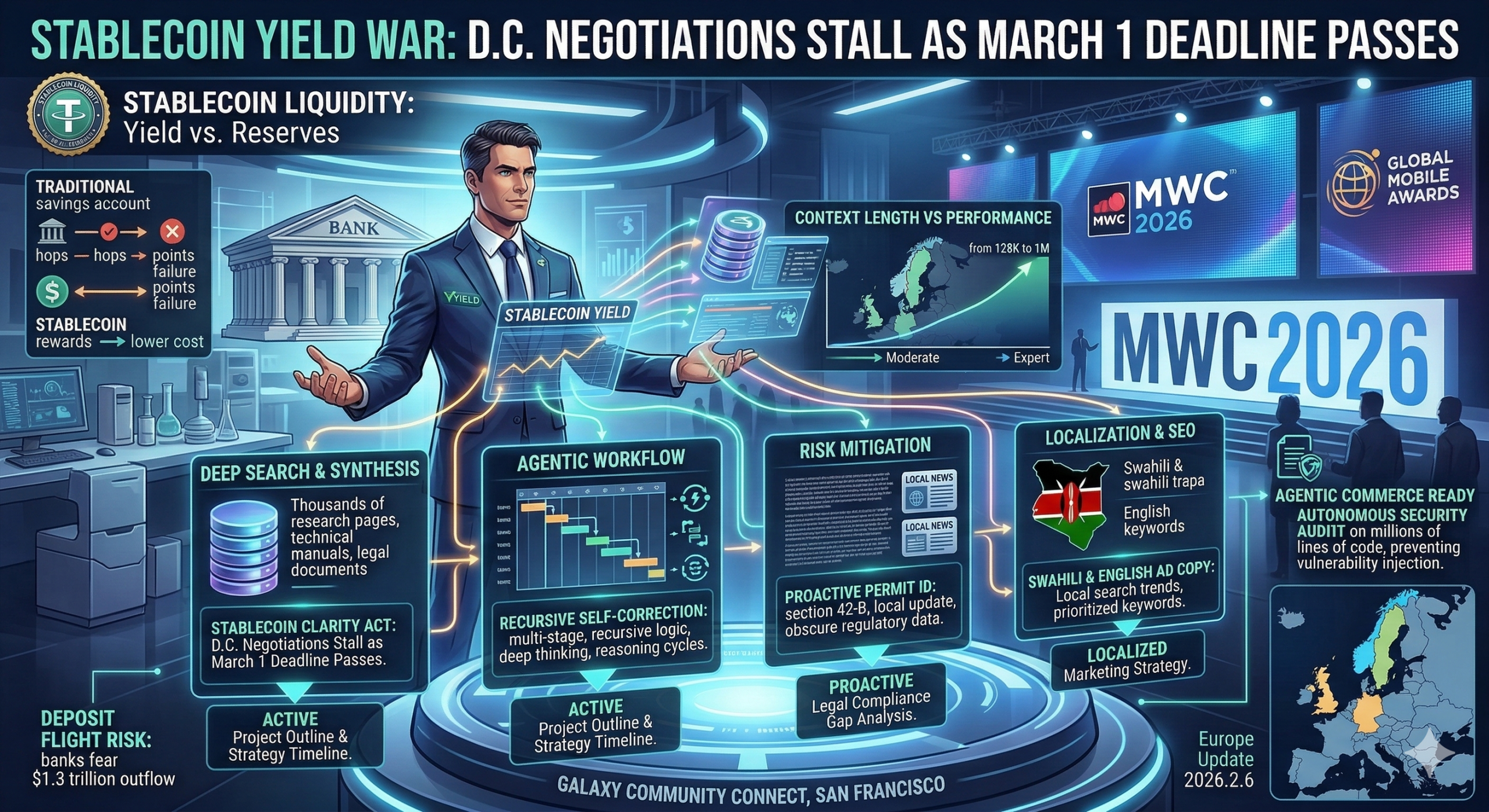
WASHINGTON, D.C. — March 8, 2026 — A high-stakes standoff over the future of the American “digital dollar” has reached a fresh impasse. Negotiations for the Digital Asset Market Clarity Act (CLARITY Act) have officially blown past the White House’s March 1 deadline, leaving the landmark legislation frozen in the Senate.
The core of the conflict is a fierce debate over stablecoin yield—specifically, whether crypto platforms like Coinbase or Kraken should be allowed to pay interest to users for simply holding dollar-linked tokens. While the White House has attempted to broker a middle-ground compromise, major U.S. banking institutions have reportedly rejected the deal, raising fears that the bill may not pass before the 2026 midterm elections.
The “Yield Ban” Battle: Banks vs. Crypto
The primary friction point is Section 404 of the CLARITY Act. This provision seeks to close a “loophole” left by last year’s GENIUS Act, which barred stablecoin issuers (like Circle) from paying interest but left the door open for intermediaries (exchanges and wallets) to offer “rewards” or “yield” to customers.
-
The Banking Position: Led by the American Bankers Association (ABA) and JPMorgan Chase CEO Jamie Dimon, banks argue that yield-bearing stablecoins are “banks in all but name.” They warn that if users can earn 4-5% APY on a digital token with instant liquidity, it could trigger a $1.3 trillion deposit flight from traditional savings accounts, crippling the ability of community banks to fund local mortgages and small business loans.
-
The Crypto Position: Industry giants like Coinbase and Ripple argue that yield is a fundamental feature of the digital asset economy. They contend that a total ban would “offshore” American innovation to Europe (under MiCA) or Asia, where yield-bearing products are being integrated into regulated frameworks.
“Americans should earn more money on their money,” President Trump posted on Truth Social earlier this week, signaling his support for the crypto industry’s stance. “We are not going to allow [banks] to undermine our powerful Crypto Agenda.”
The Failed White House Compromise
In the final week of February, Patrick Witt, Executive Director of the President’s Council of Advisers on Digital Assets, convened a “marathon mediation” in the White House Diplomatic Reception Room. The proposed compromise would have allowed “Activity-Based Rewards”—permitting yield in limited cases:
-
Peer-to-Peer Transactions: Rewards for using stablecoins for actual payments.
-
Staking & Liquidity: Yield earned for actively committing tokens to a network.
-
The “Idle” Ban: A strict prohibition on paying interest for “idle” balances that simply sit in an account—the specific feature banks fear most.
While crypto firms signaled a willingness to accept these constraints, the Bank Policy Institute (BPI) and other lenders rejected the text on March 5, maintaining that any form of reward creates an unlevel playing field.
[Image showing the “Stablecoin Liquidity Map” for 2026. A graphic highlights that USDC rewards currently sit near 4.1% APY, while the average bank savings account remains at 0.5%, illustrating the “Deposit Flight” risk cited by the Senate Banking Committee.]
What’s at Stake: The $280 Billion Market
The delay has immediate economic consequences. The stablecoin market currently exceeds $280 billion, with Tether (USDT) and Circle (USDC) acting as the primary liquidity pipes for the entire crypto ecosystem.
-
The “Narrow Bank” Model: If the CLARITY Act passes with the yield ban, it effectively turns stablecoin issuers into “narrow banks”—entities that hold 1:1 Treasury reserves but cannot offer the “perks” of traditional banking.
-
Treasury Market Impact: Regulated stablecoin issuers are already some of the largest holders of short-term U.S. debt. Analysts estimate that a clear federal framework could swell this demand to $3.7 trillion by 2030, significantly lowering the government’s borrowing costs.
Comparison: Stablecoin Yield vs. Bank Deposits (2026)
| Feature | Regulated Stablecoin (Proposed) | Traditional Savings Account |
| Current Yield (Avg) | 4.1% (via Rewards) | 0.45% – 0.60% |
| Settlement Speed | Instant (Atomic) | T+1 to T+2 Days |
| Protection | 1:1 Treasury Reserves | FDIC Insured ($250k) |
| “Yield Ban” Impact | Would drop to 0% for idle funds | No change |
What Happens Next?
With the March 1 deadline gone, the Senate Banking Committee, chaired by Tim Scott, has postponed the bill’s markup indefinitely. While JP Morgan analysts still believe a version of the CLARITY Act could be signed by mid-2026, the window is closing as the legislative calendar fills up.
For now, the status quo remains a “regulatory gray area,” where platforms continue to offer rewards while awaiting a definitive federal rulebook.
700 701 702 703 704 705 706 707 708 709 710 711 712 713 714 715 716 717 718 719 720 721 722 723 724 725 726 727 728 729 730 731 732 733 734 735 736 737 738 739 740 741 742 743 744 745 746 747 748 749 750 751 752 753 754 755 756 757 758 759 760 761 762 763 764 765 766 767 768 769 770 771 772 773 774 775 776 777 778 779 780 781 782 783 784 785 786 787 788 789 790 791 792 793 794 795 796 797 798 799 800 801 802 803 804 805 806 807 808 809 810 811 812 813 814 815 816 817 818 819 820 821 822