LONDON / SAN FRANCISCO — March 7, 2026 — The battle for the “Autonomous Engineer” is reaching a fever pitch. Just 24 hours after OpenAI unleashed GPT-5.4 and its high-velocity Codex Security preview, the developer community remains deeply divided, with Anthropic’s Claude Opus 4.6 retaining its status as the “Gold Standard” for complex architectural reasoning.
While OpenAI is banking on aggressive automation and a new “defense-first” security layer, Anthropic is doubling down on human-like precision, introducing a multi-agent architecture that allows AI teams to collaborate like a real engineering squad.
Claude Opus 4.6: The Master of “Agent Teams”
Anthropic’s latest flagship, launched in February and updated this week, introduces Agent Teams—a paradigm shift in how AI handles large-scale software engineering.
-
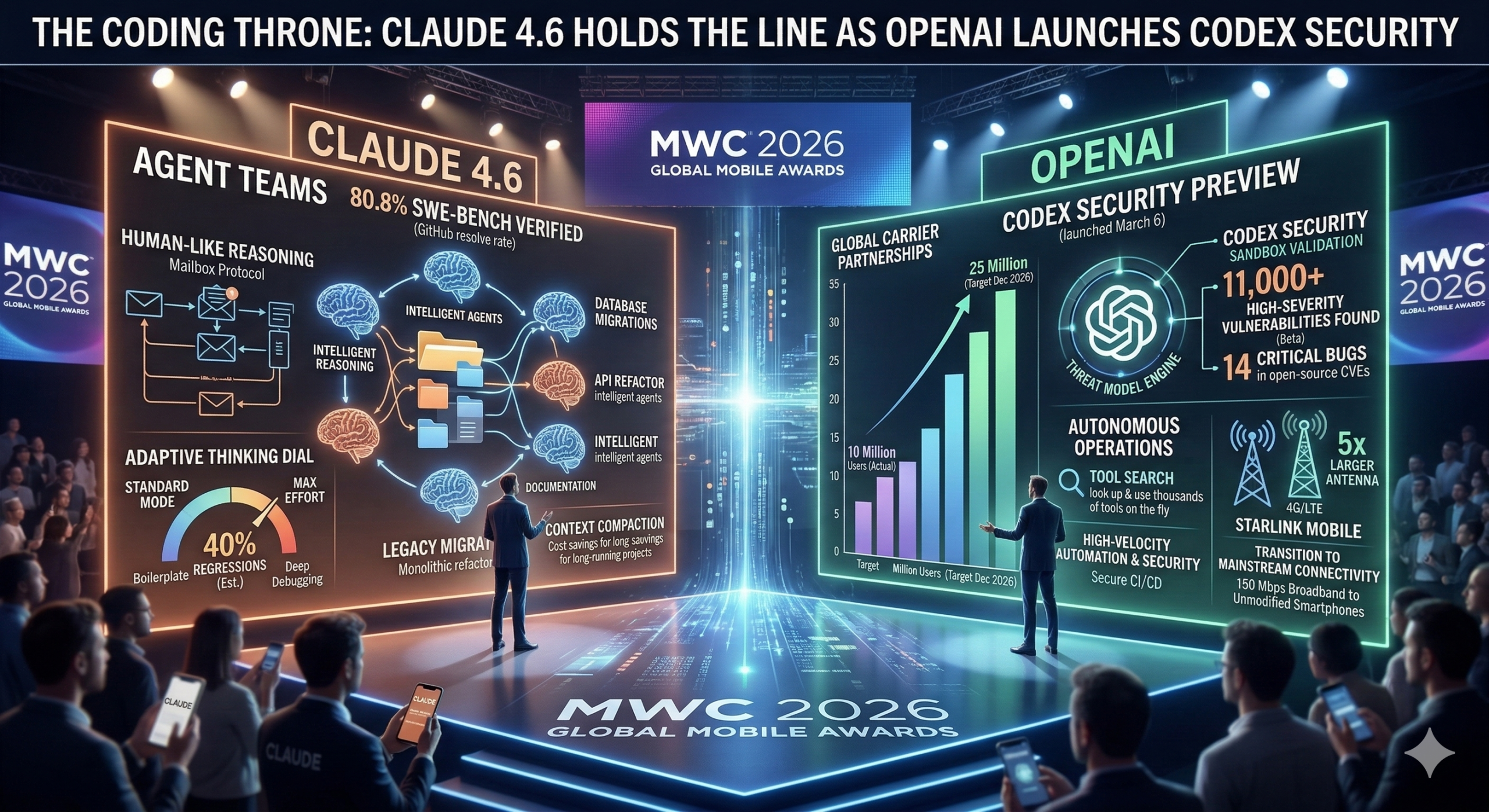
Peer-to-Peer Coordination: Rather than one model trying to do everything, Opus 4.6 can spawn a “Team” of agents that communicate via a Mailbox Protocol. One agent can focus on database migrations while another refactors the API layer, and a third writes the documentation—all in parallel.
-
80.8% SWE-bench Verified: Claude maintains the industry lead in resolving real-world GitHub issues. Its hallmark is “Logical Consistency,” with developers reporting that Claude’s patches are 40% less likely to introduce regressions compared to OpenAI’s models.
-
Adaptive Thinking: A new “dial” allows Claude to decide how much “thinking effort” to put into a task. For routine boilerplate, it stays in “Standard Mode,” but for deep debugging, it automatically shifts into “Max Effort” reasoning.
[Image showing a side-by-side comparison of the two philosophies: Claude’s “Agent Teams” (multiple brains collaborating on a complex file tree) vs. OpenAI’s “Hierarchical Orchestration” (a lead model directing sub-tasks with lightning speed).]
OpenAI’s Counter-Strike: Codex Security
OpenAI’s response, launched on March 6, is the Codex Security preview. Recognizing that agents are shipping code faster than humans can audit it, OpenAI is positioning its AI as the ultimate “Security Researcher.”
-
The Threat Model Engine: Codex Security doesn’t just scan for bugs; it builds a “Threat Model” of your entire repository. It creates isolated sandboxes to actually attempt to exploit the vulnerabilities it finds, virtually eliminating the “false positive” noise that plagues traditional scanners.
-
Codex Security Success: During its private beta, the tool identified over 11,000 high-severity vulnerabilities, including 14 critical bugs in major open-source projects that were subsequently added to the CVE database.
-
Reclaiming the Lead: While Claude wins on “Clean Code” and “Architecture,” OpenAI is reclaiming the lead in Autonomous Operations. With the new Tool Search feature, GPT-5.4 can look up and use thousands of developer tools on the fly, making it the superior choice for DevOps and CI/CD automation.
The Developer Dilemma: Depth vs. Velocity
The choice between the two has become a matter of engineering philosophy rather than raw “smartness.”
| Feature | Claude Opus 4.6 | GPT-5.4 (Codex) |
| Primary Strength | Multi-file Architectural Reasoning | High-Velocity Automation & Security |
| Key Innovation | Agent Teams (Parallel Agents) | Codex Security (Sandbox Validation) |
| Context Window | 1M Tokens (Beta with Compaction) | 1.05M Tokens (Native) |
| Price (Input/Output) | $5.00 / $25.00 per 1M | $2.50 / $15.00 per 1M (Cheaper) |
| Best For | Monolithic refactors & legacy code. | Rapid prototyping & secure CI/CD. |
The “Agentic Economy” Perspective
For business operators, the most important takeaway is the cost. OpenAI is currently 40–50% cheaper than Anthropic for standard API usage. However, Anthropic’s Context Compaction (which summarizes the start of a chat to keep it from hitting the 1M limit) can save significant money on long-running projects.
“The personality gap is narrowing, but the workflow gap is not,” says Michele Catasta, President of Replit. “Teams managing massive, layered repositories still prefer Claude’s ‘brain,’ while teams focused on aggressive automation are flocking to GPT-5.4.”
700 701 702 703 704 705 706 707 708 709 710 711 712 713 714 715 716 717 718 719 720 721 722 723 724 725 726 727 728 729 730 731 732 733 734 735 736 737 738 739 740 741 742 743 744 745 746 747 748 749 750 751 752 753 754 755 756 757 758 759 760 761 762 763 764 765 766 767 768 769 770 771 772 773 774 775 776 777 778 779 780 781 782 783 784 785 786 787 788 789 790 791 792 793 794 795 796 797 798 799 800 801 802 803 804 805 806 807 808 809 810 811 812 813 814 815 816 817 818 819 820 821 822