NEW YORK — February 28, 2026 — A defining baseline for the “agentic economy” was established today with the publication of a sweeping, international study of 6,000 C-suite executives, confirming that artificial intelligence has fundamentally graduated from a supportive “tool” to an autonomous “teammate.”
The report, titled “From Tools to Teammates: The Rise of the Multi-Agent Enterprise,” was conducted by the global consensus firm Oxford Economics in partnership with Microsoft and NVIDIA.
The core finding is unambiguous: For the first time since the generative AI boom began, AI integration is moveing measurable, macro-level productivity data, driven by a rapid shift away from individual “Copilots” toward integrated Multi-Agent Systems (MAS).
The Productivity Inflection Point
Since 2023, skepticism has lingered over whether the massive corporate investment in generative AI would translate into verifiable bottom-line results. This study provides the definitive answer.
-
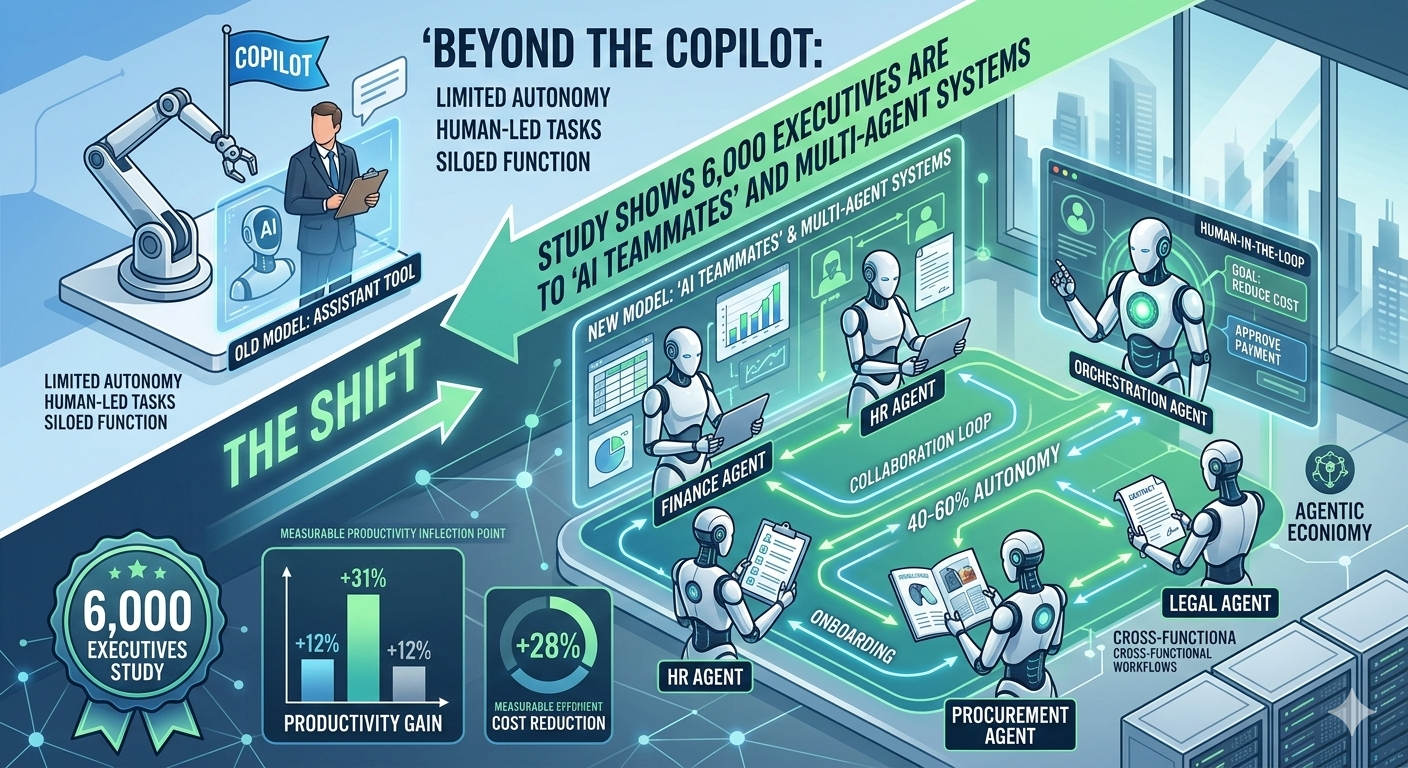
Measured Gains: Organizations that have deployed Multi-Agent Systems reported an average 31% increase in operational throughput and a 28% reduction in specific process costs over the last 12 months.
-
The Consensus: Over 82% of the 6,000 executives surveyed stated that AI-driven autonomy is now “materially evident” in their internal productivity metrics.
“We have passed the point of experimentation,” said Dr. Soumitra Dutta, Dean of Oxford Economics. “The data shows a clear inflection point. The productivity paradox of AI is resolved; the gains are real, measurable, and scaling. The differentiator is no longer using AI, but orchestrating fleets of AI.”
The Pivot to Autonomy: 40-60%
The most significant architectural shift revealed by the study is the decline of the traditional “Copilot” model. While “Copilots” require constant human prompting for every action, a Multi-Agent System (MAS) operates with a high degree of independent judgment.
An MAS consists of multiple specialized AI agents (e.g., a “finance agent,” an “HR agent,” a “legal agent”) that communicate, negotiate, and collaborate to achieve a complex goal.
The New Standard for Autonomy
The study establishes a new benchmark for corporate AI:
-
Average Autonomy: Enterprises deploying MAS now delegate 40% to 60% of core task-flow decisions to the AI agents without direct, real-time human approval.
-
The “Human-in-the-Loop” Threshold: In nearly all surveyed MAS deployments, human oversight is strictly required only at two specific points: (1) defining the high-level goal and budget, and (2) final validation/approval of critical financial or legal outputs.
“The architecture of work is being rewritten,” said Satya Nadella, Chairman and CEO of Microsoft, which participated in the study. “A copilot helps you write an email. A multi-agent team manages the entire customer support resolution process—from diagnosing the issue to updating the CRM and issuing a refund—with the human acting as the ultimate supervisor, not the driver.”
Multi-Agent Systems in Action: Cross-Functional Flows
The study highlights that the deepest productivity gains are achieved when specialized agents break down silos and collaborate across departmental lines. The report details several production-scale case studies:
-
Supply Chain Operations: In a global manufacturing firm, a ‘procurement agent’ identified a supply shortage, then automatically negotiated pricing with alternative suppliers using a ‘contract agent’ for compliance check. Finally, it instructed the ‘logistics agent’ to re-route shipping, only alerting a human manager when the projected cost exceeded 15% of the original budget.
-
Employee Onboarding: A single ‘HR orchestration agent’ managed the entire onboarding process for a 500-person cohort. It coordinated sub-agents for IT provisioning, background check validation, payroll setup, and training scheduling, reducing the onboarding lifecycle from 14 days to 48 hours.
Challenges and Future Outlook
Despite the strong productivity data, the report identifies critical friction points. Data quality and interoperability remain the top barriers to MAS deployment (68% of executives). Perhaps more significantly, 74% of respondents reported that managing “agentic drift”—where autonomous agents begin to make decisions inconsistent with organizational intent—is their primary governance challenge for 2026.
“The next phase is governance,” added Dutta. “We are moving from a world of managing people to a world of managing autonomous systems. The tools for that management—the ‘agent supervisors’—are the next critical technology.”
| Metric | MAS Deploying Orgs | Non-MAS Orgs (Copilot only) |
| Op. Productivity Gain (Avg) | +31% | +12% |
| Process Cost Reduction (Avg) | +28% | +9% |
| Autonomy Level (Avg) | 40-60% | 5-10% |
| Exec. Reportable Metrics | 82% Confirmed | 35% Confirmed |
700 701 702 703 704 705 706 707 708 709 710 711 712 713 714 715 716 717 718 719 720 721 722 723 724 725 726 727 728 729 730 731 732 733 734 735 736 737 738 739 740 741 742 743 744 745 746 747 748 749 750 751 752 753 754 755 756 757 758 759 760 761 762 763 764 765 766 767 768 769 770 771 772 773 774 775 776 777 778 779 780 781 782 783 784 785 786 787 788 789 790 791 792 793 794 795 796 797 798 799 800 801 802 803 804 805 806 807 808 809 810 811 812 813 814 815 816 817 818 819 820 821 822