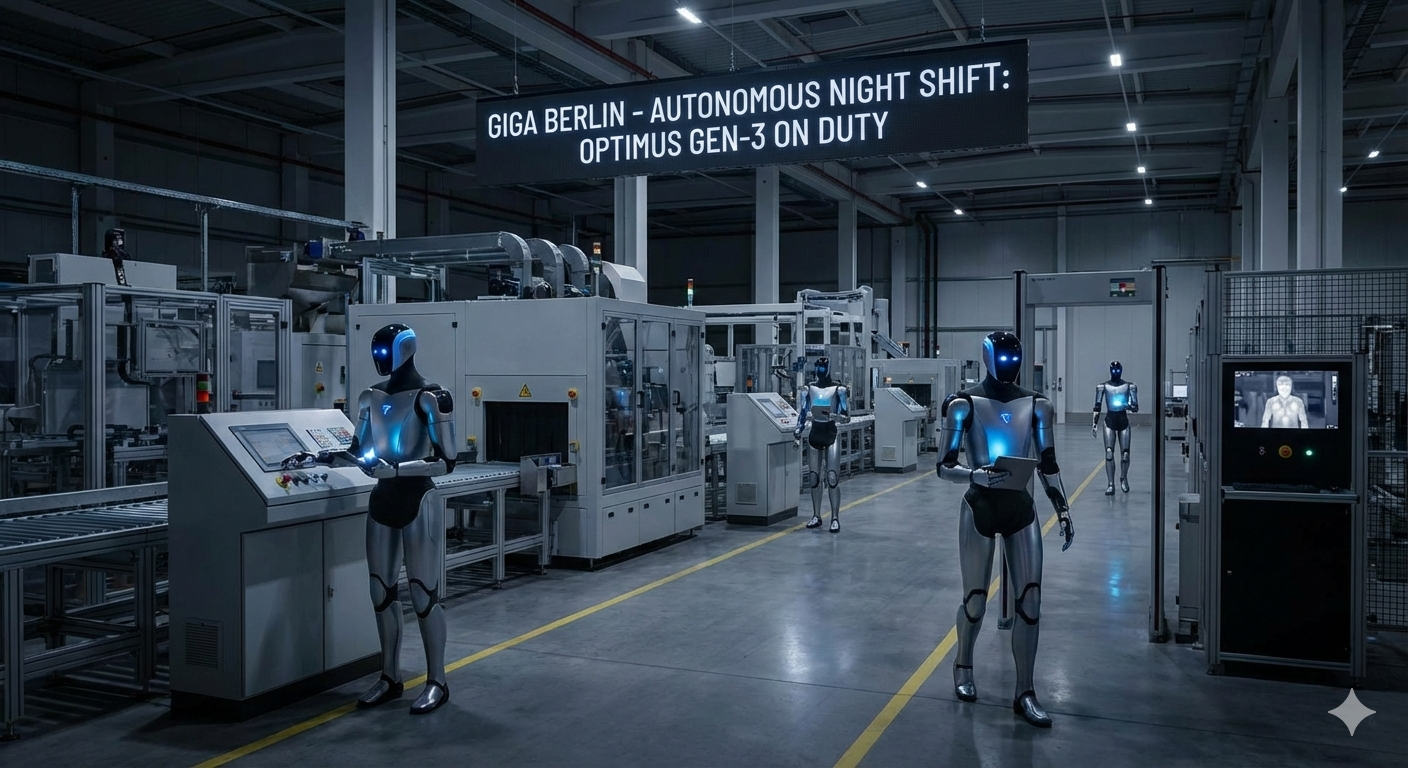
GRÜNHEIDE, GERMANY – January 26, 2026 – As the sun set over Tesla’s sprawling Giga Berlin complex yesterday evening, a historic shift change occurred. For the first time in the facility’s history, the human night-watch and maintenance crews did not clock in. Instead, the immense factory floor was turned over to a fleet of Tesla Optimus Gen-3 humanoid robots.
This deployment marks the official start of fully autonomous facility management for Tesla and serves as the ultimate real-world validation test for Elon Musk’s ambitious robotics program. The humanoid units are now solely responsible for the security and operational readiness of the multi-billion dollar plant between the hours of 10:00 PM and 6:00 AM.
“FSD for Legs”: The End-to-End Brain
The critical breakthrough enabling this deployment is not mechanical, but cognitive. The Optimus Gen-3 units are not operated by telepresence, nor are they following pre-programmed paths like traditional warehouse AGVs (Automated Guided Vehicles).
They are powered by the exact same “End-to-End” neural network architecture that drives Tesla’s vehicles running FSD (Full Self-Driving) v13.
“We simply retrained the model,” explained Dr. Sivaram Balasubramanian, Tesla’s Director of AI in a post on X. “Instead of inputting road camera data and outputting steering torque, we input factory camera data and output bipedal actuator torque. The AI doesn’t see ‘aisles’ or ‘machines’; it sees traversable space and obstacles, just as a car sees lanes and traffic.”
This allows the robots to dynamically navigate cluttered environments, step over stray tools, climb metal stairs to inspect mezzanine levels, and adapt instantly if a forklift has been left in an unexpected path.
More Than Just Security: The Multi-Role Night Shift
While their primary mandate is security, calling them “watchmen” undersells their capabilities. The Gen-3 units, equipped with advanced thermal imaging, acoustic sensors, and high-fidelity cameras, perform a dual role:
1. Active Security & Intruder Response: The robots patrol in randomized patterns. Their neural nets are trained to identify “anomalous human presence” during off-hours. If an intruder is detected, the Optimus unit is programmed to track the individual, strobe blinding LED safety lights, broadcast verbal warnings, and instantly relay live video to a centralized, human-staffed GSOC (Global Security Operations Center) in Palo Alto for law enforcement dispatch.
2. Autonomous Maintenance & Prep: Crucially, the robots utilize their dexterous, 22-degree-of-freedom hands to perform actual labor. During their patrols, they are tasked with:
-
Restocking Line-Side Inventory: Ensuring critical fasteners and components are ready for the human morning shift.
-
Safety Audits: Visually inspecting hydraulic presses for leaks or thermal anomalies.
-
Basic Janitorial Tasks: Identifying and cleaning spill hazards on the concrete floors.
The Human Cost and Industrial Pushback
The deployment at Giga Berlin has resulted in the displacement of approximately 50 human workers who previously handled night security and basic maintenance.
While Tesla has stated that a majority of these workers were offered retraining programs for higher-skilled daytime roles in battery cell production, the move has drawn sharp criticism from IG Metall, Germany’s powerful industrial union.
“We were promised that robots would take the dangerous and boring jobs alongside humans, not replace whole shifts overnight,” stated union representative Klaus Müller. “Using Giga Berlin as a laboratory for labor replacement is a dangerous precedent for the entire European manufacturing sector.”
The Ultimate Showroom
Industry analysts view the Giga Berlin deployment as a massive, high-stakes advertisement for the commercial release of Optimus, slated for late 2026. Tesla is effectively telling potential enterprise customers: If we trust these machines with our most valuable factory, you can trust them with yours.
If the Giga Berlin pilot proves successful over the next 90 days, Tesla aims to expand the program to Giga Texas and Giga Shanghai by Q3 2026, effectively automating the “graveyard shift” across its global operations.
1 2 3 4 5 6 7 8 9 10 11 12 13 14 15 16 17 18 19 20 21 22 23 24 25 26 27 28 29 30 31 32 33 34 35 36 37 38
700 701 702 703 704 705 706 707 708 709 710 711 712 713 714 715 716 717 718 719 720 721 722 723 724 725 726 727 728 729 730 731 732 733 734 735 736 737 738 739 740 741 742 743 744 745 746 747 748 749 750 751 752 753 754 755 756 757 758 759 760 761 762 763 764 765 766 767 768 769 770 771 772 773 774 775 776 777 778 779 780 781 782 783 784 785 786 787 788 789 790 791 792 793 794 795 796 797 798 799 800 801 802 803 804 805 806 807 808 809 810 811 812 813 814 815 816 817 818 819 820 821 822