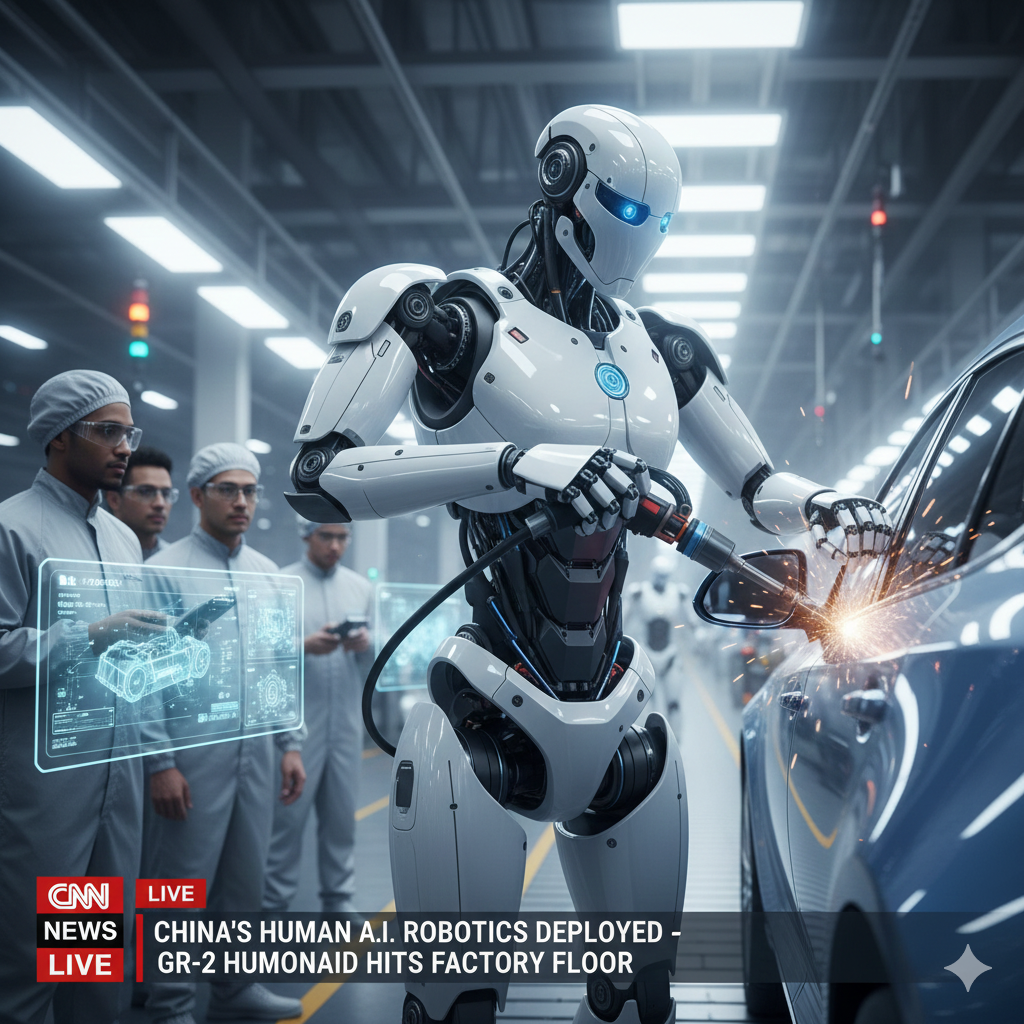
SHANGHAI, CHINA – December 27, 2025 – In a significant milestone for robotics and industrial automation, China’s leading humanoid robotics company, Fourier Intelligence, has officially deployed its advanced GR-2 bipedal robot to several major car manufacturing plants across the country. This marks the first time a commercially available humanoid robot has been integrated directly into a production line for tasks requiring what the company describes as “human-like judgment.”
The deployment is part of a strategic initiative to boost efficiency and safety in China’s rapidly expanding automotive sector, and it signals a new phase in the global race for humanoid robot development.
Beyond Repetitive Tasks: The GR-2’s Capabilities
Historically, industrial robots have been largely stationary robotic arms performing repetitive, high-precision tasks. The GR-2, however, represents a new class of versatile, mobile automation.
-
Bipedal Dexterity: Standing at 1.65 meters (5 feet 5 inches) tall and weighing 55 kg (121 lbs), the GR-2 is designed to navigate complex factory environments, walk around obstacles, and interact with tools and machinery in ways previously exclusive to human workers.
-
“Human-Like Judgment”: Fourier Intelligence CEO Gu Jie emphasized that the GR-2 isn’t just performing simple, pre-programmed movements. Equipped with advanced sensors, AI-powered vision systems, and sophisticated haptic feedback, the robots are reportedly capable of:
-
Quality Inspection: Identifying subtle defects in car parts that require a degree of visual discernment.
-
Tool Handling: Picking up and using a variety of tools that might be arranged unpredictably or require adaptive grip strength.
-
Adaptive Assembly: Performing intricate assembly steps that may vary slightly between vehicle models, requiring “on-the-fly” adjustments.
-
Collaboration: Working safely alongside human employees, adapting its movements to ensure no collisions.
-
-
Payload and Speed: The GR-2 can carry a payload of up to 50 kg (110 lbs) and boasts a walking speed of 5 km/h, making it robust enough for various factory roles.
Addressing Labor Gaps and Boosting Efficiency
The deployment comes as China’s manufacturing sector faces an aging workforce and increasing labor costs. Humanoid robots like the GR-2 offer a potential solution to these challenges:
-
Bridging Labor Gaps: Taking on roles that are either physically demanding, repetitive, or undesirable for human workers, thereby addressing labor shortages.
-
Increased Efficiency: Operating 24/7 without fatigue, leading to higher throughput and consistent quality.
-
Safety Improvement: Reducing human exposure to hazardous environments or strenuous tasks, leading to fewer workplace injuries.
Global Race for Humanoid Supremacy
Fourier Intelligence’s move places China at the forefront of humanoid robot deployment in real-world industrial settings, intensifying competition with Western companies like Boston Dynamics, Agility Robotics, and Tesla, all of whom are developing their own bipedal robots.
“This isn’t a speculative demo; this is real-world deployment in a demanding industrial environment,” noted Dr. Li Wei, a robotics expert at Tsinghua University. “The GR-2’s integration into automotive production lines is a powerful statement about the maturity of China’s humanoid robot technology and its potential to transform global manufacturing.”
As the GR-2 begins its new role on the factory floor, the world will be watching closely to see how these humanoids perform and what impact they will have on the future of work.
700 701 702 703 704 705 706 707 708 709 710 711 712 713 714 715 716 717 718 719 720 721 722 723 724 725 726 727 728 729 730 731 732 733 734 735 736 737 738 739 740 741 742 743 744 745 746 747 748 749 750 751 752 753 754 755 756 757 758 759 760 761 762 763 764 765 766 767 768 769 770 771 772 773 774 775 776 777 778 779 780 781 782 783 784 785 786 787 788 789 790 791 792 793 794 795 796 797 798 799 800 801 802 803 804 805 806 807 808 809 810 811 812 813 814 815 816 817 818 819 820 821 822