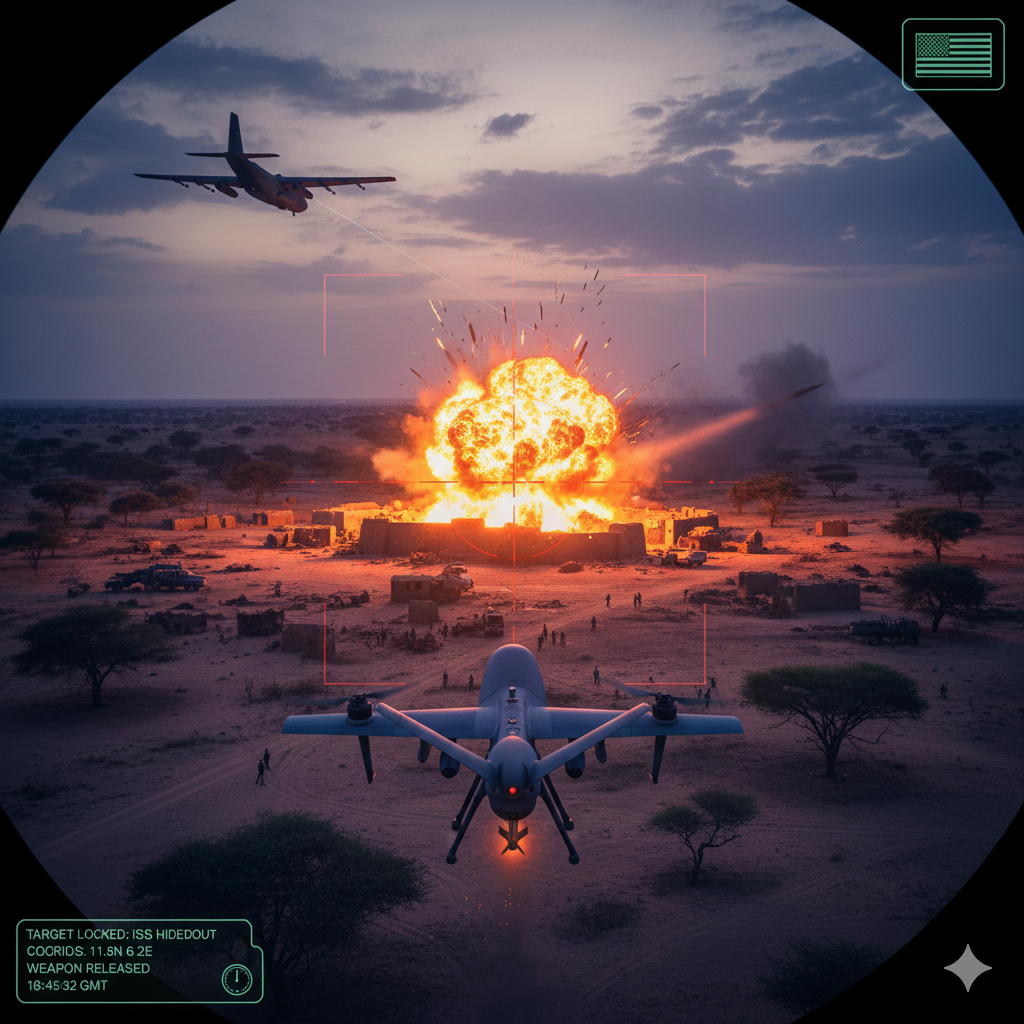
WASHINGTON D.C. / ABUJA – December 26, 2025 – President Donald Trump and the Pentagon today confirmed that U.S. forces conducted a series of precision airstrikes against Islamic State (ISIS) targets in northwest Nigeria on Christmas Day. The operation, reportedly carried out at the explicit request of the Nigerian government, aimed to degrade terrorist capabilities and protect civilian populations from escalating violence.
“Decisive Action” on Christmas Day
Speaking from Mar-a-Lago, President Trump stated, “Yesterday, on Christmas Day, our brave men and women in uniform delivered a strong message to radical Islamic terrorists who seek to harm innocent lives. We responded swiftly to a direct request from our partners in Nigeria to protect their people.”
The Pentagon later released a more detailed statement, confirming that MQ-9 Reaper drones and at least one AC-130 gunship were used in the strikes. The targets were identified as ISIS strongholds and logistics hubs in Zamfara State, a region that has seen a surge in violence attributed to ISIS West Africa Province (ISWAP) and its affiliates.
-
Targets: Intelligence indicated the destroyed sites were used for planning attacks, storing weapons, and coordinating abduction campaigns.
-
Casualties: The Pentagon claimed “numerous enemy combatants” were killed, with no civilian casualties reported, though this is yet to be independently verified.
-
Nigerian Request: According to U.S. officials, the Nigerian government provided specific intelligence and requested immediate assistance following a series of brutal attacks on rural villages over the past month.
Escalation in Northwest Nigeria
Northwest Nigeria has become an increasingly volatile front in the global fight against terrorism. While Boko Haram traditionally operated in the northeast, ISWAP has expanded its influence, exploiting local grievances and rivalries to establish a significant presence in Zamfara, Katsina, and Kaduna states.
-
ISWAP’s Strategy: The group has focused on extorting local communities, kidnapping for ransom, and disrupting agricultural activities, leading to widespread displacement and food insecurity.
-
Civilian Impact: Recent reports from NGOs indicate that over 3,000 civilians have been killed in the northwest in 2025, with hundreds of thousands displaced. The Nigerian military has struggled to contain the multi-front insurgency.
Geopolitical Implications
The U.S. intervention marks a significant shift in its engagement with Nigeria, moving beyond advisory and training roles to direct kinetic action.
-
Regional Stability: The strikes underscore Washington’s growing concern over the destabilizing effect of ISIS in the Sahel region, which stretches across West and North Africa.
-
Sovereignty Concerns: While reportedly requested, direct U.S. military action on Nigerian soil could raise questions about sovereignty and precedent, particularly if the campaign expands.
-
African Command (AFRICOM): The operation falls under the purview of AFRICOM, which has been increasingly active in countering extremist groups across the continent.
Both the U.S. and Nigerian governments have vowed to continue their cooperation against terrorism, with further actions not ruled out.
700 701 702 703 704 705 706 707 708 709 710 711 712 713 714 715 716 717 718 719 720 721 722 723 724 725 726 727 728 729 730 731 732 733 734 735 736 737 738 739 740 741 742 743 744 745 746 747 748 749 750 751 752 753 754 755 756 757 758 759 760 761 762 763 764 765 766 767 768 769 770 771 772 773 774 775 776 777 778 779 780 781 782 783 784 785 786 787 788 789 790 791 792 793 794 795 796 797 798 799 800 801 802 803 804 805 806 807 808 809 810 811 812 813 814 815 816 817 818 819 820 821 822